Inulinase Specification Checklist for Fructose Production
Compare inulinase specs for converting inulin fiber from chicory or agave into fructose. pH, temperature, dosage, QC, COA/TDS/SDS.
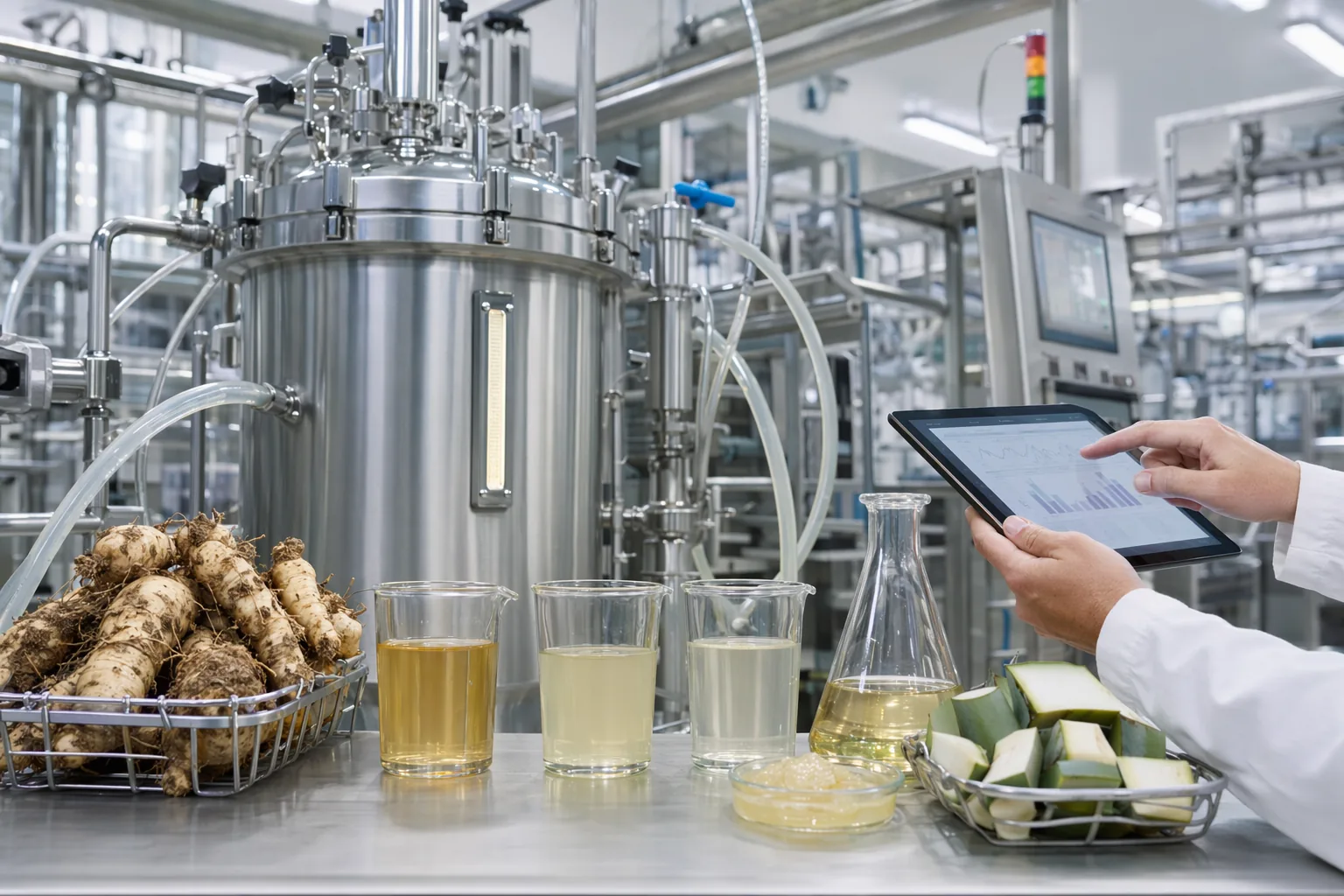
For manufacturers and resellers comparing inulinase options to convert inulin fiber from chicory, agave or Jerusalem artichoke streams into fructose-rich syrup with controlled yield, quality and cost-in-use. Buying for production or resale? Request a wholesale quote with the product, the quantity per order or per month and the destination country at hello@mail.enzymeproject.com, or use the quote form on our home page.
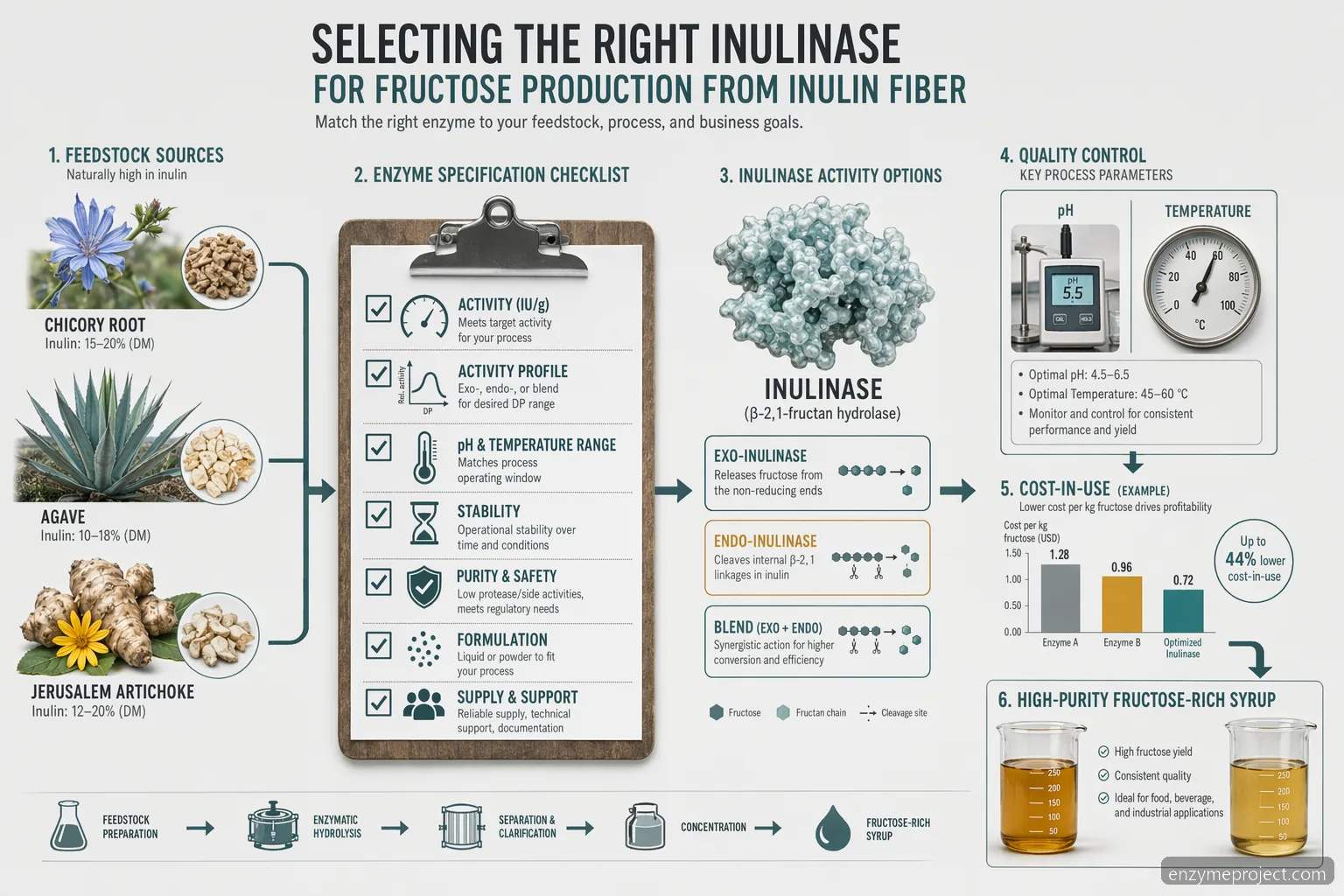
Why Inulinase Selection Matters for Inulin Fiber Conversion
In fructose production, inulinase is used to hydrolyze inulin fiber, a fructan commonly sourced from chicory root inulin, agave inulin, or other botanical materials. Buyers often begin with questions such as what is inulin, inulin what is it, or how inulin powder differs from starch-based sweetener feedstocks. From a processing perspective, inulin is a chain of fructose units typically ending with glucose, and the enzyme system determines whether the hydrolysate becomes fructose-rich syrup, a partial fructooligosaccharide stream, or a mixed profile. Exo-inulinase generally favors fructose release, while endo-inulinase can generate shorter inulin with FOS fractions. The right specification depends on the feedstock degree of polymerization, solids level, pretreatment, and target sweetness. For B2B purchasing, the main comparison is not supplement positioning but process performance, documentation, stability, and repeatable conversion economics.
Define target: high fructose yield, partial hydrolysis, or inulin with FOS profile. • Confirm feedstock: chicory inulin, agave inulin, extract, syrup, or inulin powder. • Compare enzyme activity using the same assay basis where possible.
Core Process Conditions to Confirm Before Quotation
Most commercial inulinase applications for fructose from inulin are evaluated in mildly acidic conditions, commonly around pH 4.5 to 5.5, with operating temperatures often in the 50 to 60 °C range. Some preparations may tolerate wider or narrower windows, so the TDS should be checked against your process constraints. Initial screening dosages may fall around 0.1 to 1.0 kg enzyme preparation per metric ton of dry inulin substrate, or an equivalent activity-unit dosage, but this must be optimized in pilot work. Higher solids can improve plant productivity but may reduce mixing efficiency and increase viscosity. Residence time is typically set by target dextrose-equivalent-style reducing sugar release, fructose concentration, and by-product limits. Buyers should also confirm whether enzyme deactivation is possible through heat treatment, pH adjustment, or downstream evaporation conditions without affecting syrup color or flavor.
Typical screening pH: 4.5–5.5, subject to enzyme TDS. • Typical screening temperature: 50–60 °C, subject to stability data. • Typical starting dosage: 0.1–1.0 kg/MT dry substrate or activity-equivalent.
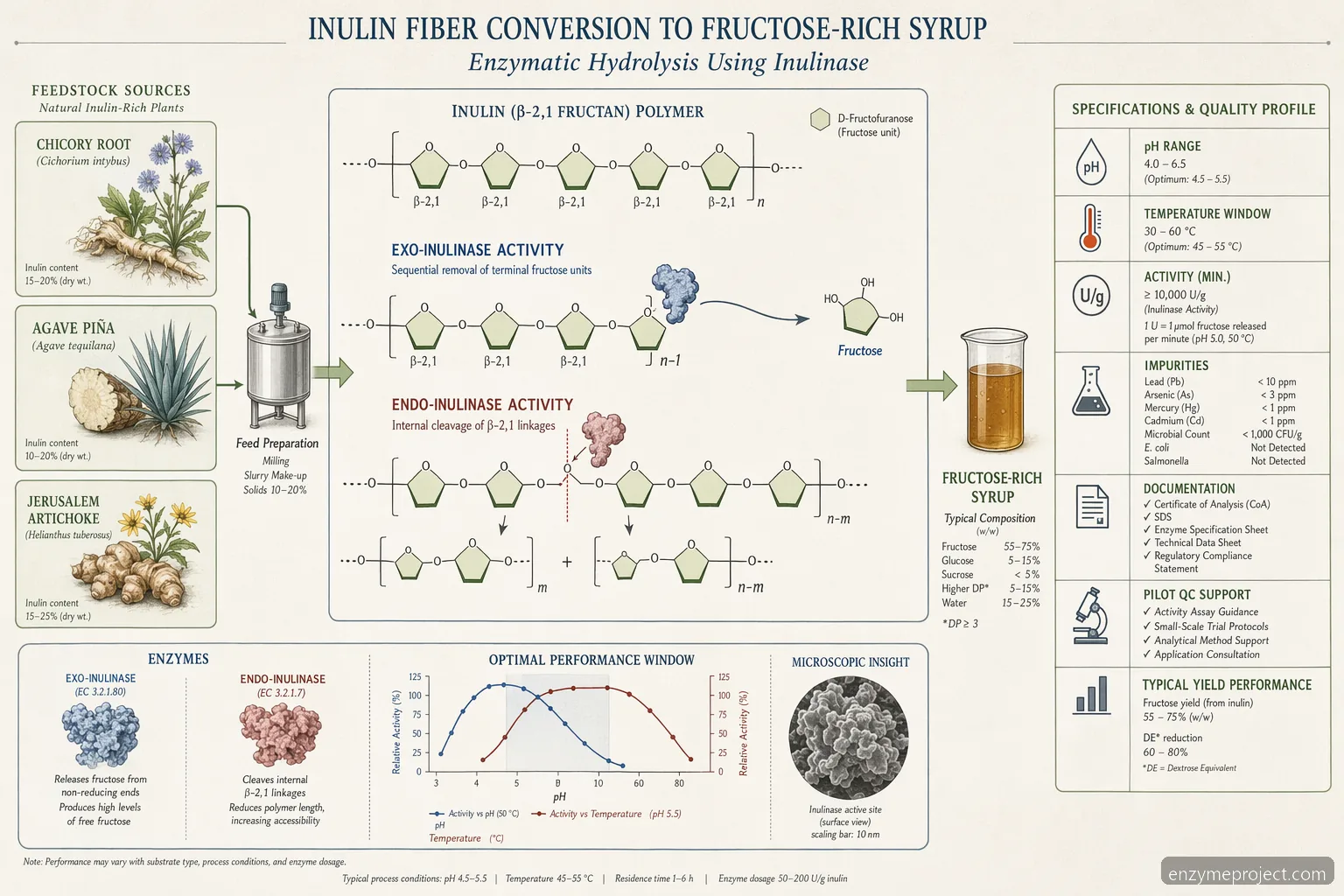
Comparing Inulinase Types: Exo, Endo, and Blended Activity
For industrial fructose production, enzyme mechanism is a major purchasing criterion. Exo-inulinase releases terminal fructose units and is generally preferred when the target is a fructose-rich hydrolysate from inulin fiber. Endo-inulinase cleaves internal fructan bonds and may be useful when the desired output includes shorter fructooligosaccharides, often discussed commercially as inulin with FOS. Some enzyme products contain mixed activities, which can be advantageous or problematic depending on the syrup specification. Buyers should ask whether the activity method measures fructose release from inulin, activity on sucrose, or a broader fructan substrate. Activity numbers are not always directly comparable across suppliers. In RFQs, specify your feedstock, dry solids, pH, temperature, residence time, target fructose percentage on carbohydrates, and acceptable residual oligosaccharide level. This avoids selecting a chicory enzyme solution that performs well in a brochure but misses your process target.
Exo-inulinase: typically selected for maximum fructose release. • Endo-inulinase: useful for partial hydrolysis and FOS-rich profiles. • Blends: validate final sugar profile by HPLC or equivalent method.
Documentation Required from an Industrial Enzyme Supplier
A qualified inulinase supplier should provide documentation before plant introduction, not after problems appear. Request a current COA for the offered lot, a technical data sheet with activity definition and recommended conditions, and an SDS covering handling, storage, and safety controls. For food sweetener manufacturing, also request statements relevant to intended market access, such as food-processing suitability, allergen information, carrier composition, and country-of-origin details where needed. Avoid vague activity claims that do not identify substrate, assay pH, assay temperature, and unit definition. The COA should allow incoming QC to compare activity, appearance, moisture or formulation basis where applicable, microbiological limits, and lot traceability. Supplier qualification should also evaluate change-control practices, batch-to-batch consistency, lead time, packaging integrity, technical service capability, and whether the supplier can support pilot validation with realistic sample quantities.
Required: COA, TDS, SDS, activity method, storage conditions. • Useful: allergen, carrier, origin, traceability, and change-control statements. • Confirm whether samples and scale-up support are available.
Pilot Validation and QC Checks for Fructose Production
Pilot validation should reproduce the commercial process as closely as possible: same inulin powder or extract, comparable dry solids, water quality, agitation, pH control, temperature ramp, and residence time. Track pH, temperature, viscosity, brix, reducing sugars, fructose, glucose, sucrose, residual inulin, and FOS distribution. HPLC is commonly used to confirm carbohydrate profile; refractometry alone is not enough to prove conversion. Run a no-enzyme control and at least three enzyme dosages to estimate response curve and cost-in-use. Also test enzyme addition point, substrate pretreatment, and hold-time stability. After hydrolysis, confirm deactivation and downstream compatibility with filtration, decolorization, ion exchange, evaporation, or crystallization if used. The best enzyme is the one that meets the target syrup specification consistently under plant constraints, not the one with the highest catalog activity value.
Use HPLC or equivalent carbohydrate profiling for conversion confirmation. • Run dosage-response trials before locking commercial dosage. • Verify deactivation and downstream processing compatibility.
Cost-in-Use and Supplier Qualification Checklist
Comparing inulinase quotes only by price per kilogram can be misleading because enzyme concentration, activity definition, storage stability, and dosage response vary. Cost-in-use should be calculated as enzyme cost per metric ton of dry inulin processed, per kilogram of fructose produced, or per target syrup solids unit. Include yield, conversion time, tank occupancy, energy, pH adjustment, filtration impact, product losses, and waste handling. Supplier qualification should cover commercial availability, shelf life, packaging sizes, cold-chain or ambient storage requirements, technical support, and ability to provide consistent lots. Clarify whether the formulation contains stabilizers, salts, or carriers that affect ash, color, flavor, or labeling in your market. For search terms such as inulin insulin, buyers should distinguish terminology: inulin is a fructan feedstock, while insulin is a hormone and not relevant to industrial enzyme conversion.
Calculate enzyme cost per ton of dry substrate and per kilogram of fructose. • Include yield, residence time, and downstream effects in total economics. • Qualify supply reliability before moving from pilot to production.
Inulinase for Research & Industry
Need Inulinase for your lab or production process?
ISO 9001 certified · Food-grade & research-grade · Ships to 80+ countries
Frequently Asked Questions
What is inulin in an industrial fructose process?
Inulin is a fructan carbohydrate made mainly of fructose units and is found in sources such as chicory root and agave. In an industrial fructose process, inulin fiber is treated as a feedstock rather than as a dietary supplement ingredient. Inulinase hydrolyzes the fructan bonds to produce fructose-rich syrups or, with partial hydrolysis, shorter fructooligosaccharide fractions.
Is chicory inulin different from agave inulin for enzyme selection?
Yes, the source can affect degree of polymerization, impurities, viscosity, mineral content, and pretreatment needs. Chicory root inulin and agave inulin may both be suitable for inulinase conversion, but they should not be assumed to perform identically. Pilot trials should use the actual commercial feedstock, target solids, and process water to confirm dosage, conversion rate, filtration behavior, and final carbohydrate profile.
What inulinase conditions should be tested first?
A practical first screen often uses pH 4.5 to 5.5, temperature around 50 to 60 °C, and a dosage ladder near 0.1 to 1.0 kg enzyme preparation per metric ton of dry inulin substrate, or the supplier’s activity-equivalent recommendation. These are starting points only. The final setpoints should be based on your enzyme TDS, feedstock, residence time, target fructose yield, and downstream constraints.
How should buyers compare inulinase enzyme quotations?
Compare quotations by cost-in-use, not only price per kilogram. Normalize offers by activity method, dosage needed for target conversion, reaction time, yield, storage stability, packaging, and technical support. Ask each supplier for COA, TDS, SDS, activity definition, sample availability, and expected lead time. A lower-priced enzyme can be more expensive if it requires higher dosage or longer tank residence.
What QC checks confirm successful fructose production from inulin?
Brix and reducing sugar tests are useful for monitoring, but they do not fully define the carbohydrate profile. Use HPLC or an equivalent validated method to measure fructose, glucose, sucrose, residual inulin, and FOS distribution. Also record pH, temperature, time, solids, viscosity, color, and deactivation conditions. These data support process control, supplier comparison, and scale-up decisions.
Request a Wholesale Quote
Manufacturers, ingredient distributors and resellers: send the product or target output, the quantity per order or per month and the destination country to hello@mail.enzymeproject.com; volumes and prices are quoted per order. Request an inulinase specification review, pilot sample, and cost-in-use comparison for your fructose production line. See our application page for Turn inulin into higher-value ingredients at /applications/inulin-vs-psyllium-husk/ for specs, MOQ, and a free 50 g sample.
Contact Us to Contributehello@mail.enzymeproject.com