Inulinase Supplier Guide for Fructose Production from Inulin Powder
Source inulinase for converting inulin powder, chicory root inulin, or agave inulin into fructose with process guidance and QC checks.
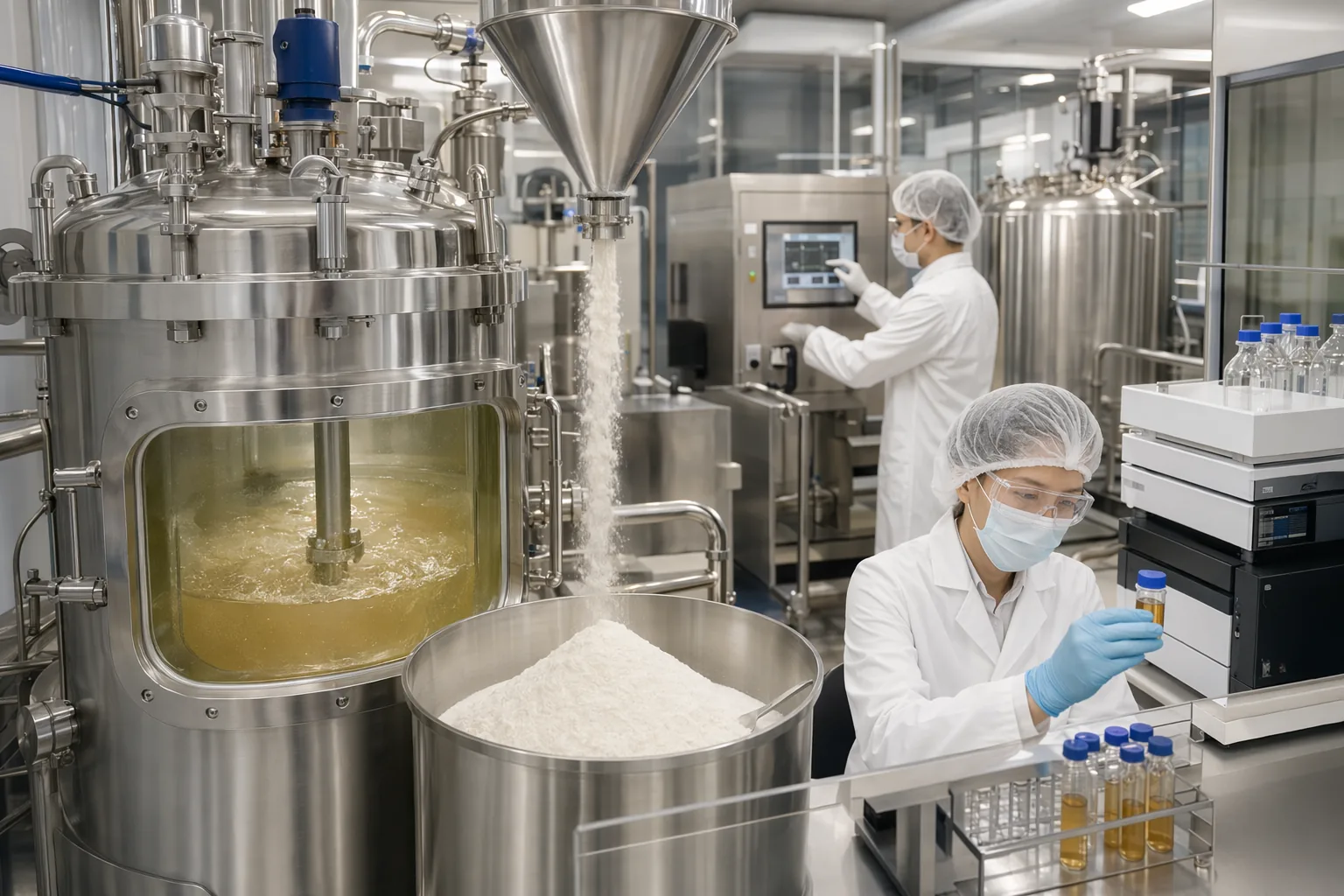
Evaluate industrial inulinase for reliable hydrolysis of inulin powder into fructose-rich syrups, with practical process conditions, supplier qualification steps, and cost-in-use factors for B2B buyers.
Buying for production or resale? Request a wholesale quote with the product, the quantity per order or per month and the destination country at hello@mail.enzymeproject.com, or use the quote form on our home page.
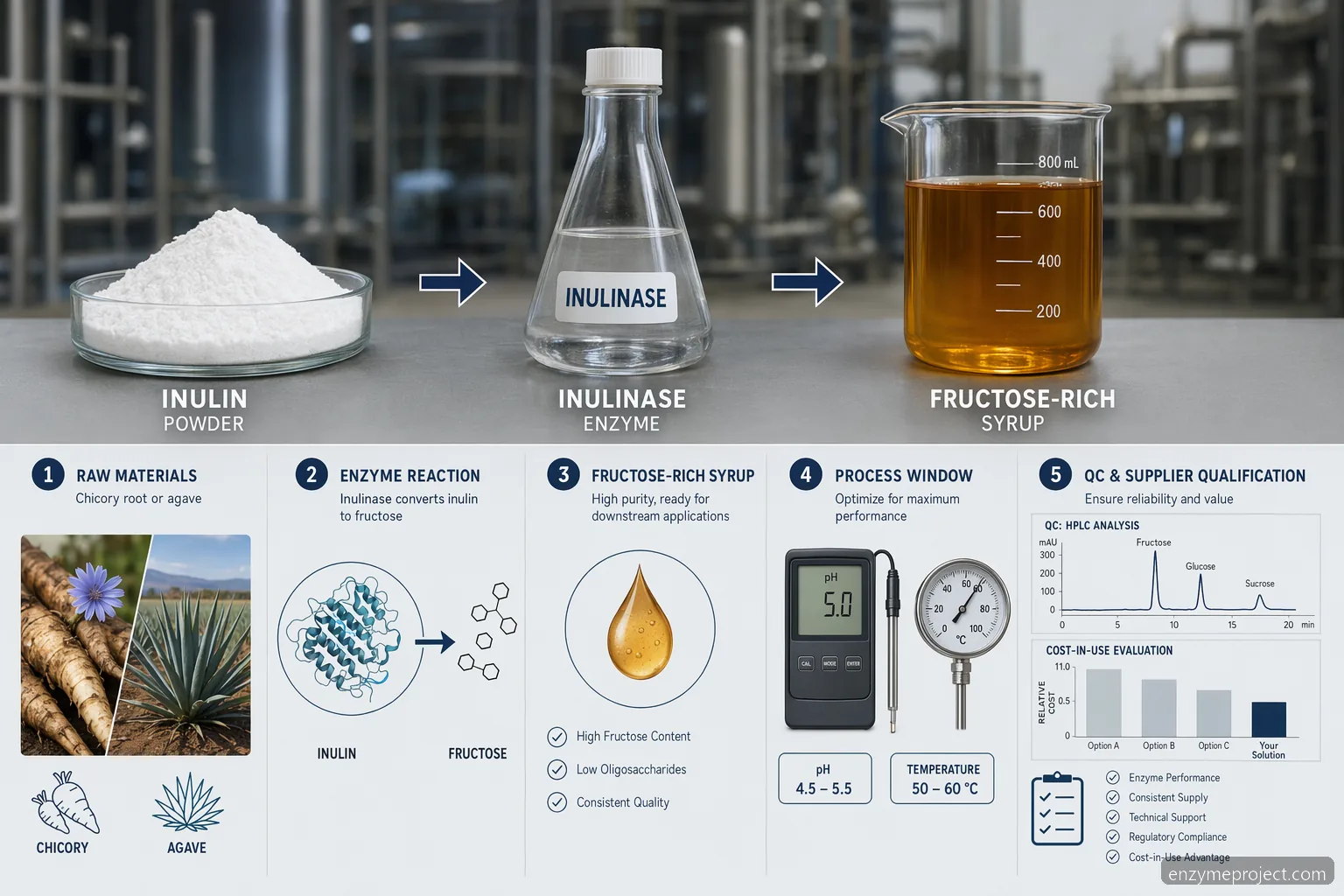
Why inulinase matters when processing inulin powder
For industrial fructose production, inulinase is used to hydrolyze beta-2,1 fructan linkages in inulin powder and related substrates. Buyers asking “what is inulin” or “inulin what is it” are often comparing raw material options such as chicory inulin, chicory root inulin, agave inulin, and inulin with FOS. In this context, the question is not supplement positioning; it is whether the substrate can be converted predictably into a fructose-rich syrup at commercial solids. A qualified inulinase enzyme program helps processors reduce unconverted oligosaccharides, improve sweetness profile consistency, and define downstream clarification requirements. Because feedstock composition varies by botanical source and supplier, enzyme selection should be based on measured conversion data, not generic activity claims. The best sourcing approach combines lab screening, pilot validation, and review of COA, TDS, and SDS documentation before scale-up.
Primary use: fructose production from inulin-containing substrates • Relevant substrates: chicory root inulin, agave inulin, and FOS-rich materials • Commercial objective: consistent hydrolysis, filtration behavior, and syrup quality
Recommended process window for fructose-rich syrup
A practical starting point for inulinase trials is a slurry or solution of inulin powder at 10-35% dry solids, adjusted within the enzyme supplier’s recommended pH range. Many industrial inulinase preparations operate effectively around pH 4.0-6.0 and 45-60°C, but the exact optimum depends on microbial source, formulation, and process matrix. Dosage screening commonly begins around 0.1-1.0% enzyme product on dry substrate, or an equivalent activity-based dosage when activity units are provided. Reaction time may range from 4-24 hours depending on desired fructose yield, viscosity, solids, and heat transfer. Process teams should monitor pH drift, microbial control, and solids dissolution before judging enzyme performance. After hydrolysis, enzyme inactivation may be performed by heat treatment if compatible with color and flavor targets. Trials should include blanks and a benchmark enzyme to support a clear cost-in-use comparison.
Typical pH screening: 4.0-6.0 • Typical temperature screening: 45-60°C • Initial dosage band: 0.1-1.0% on dry substrate • Typical reaction time: 4-24 hours
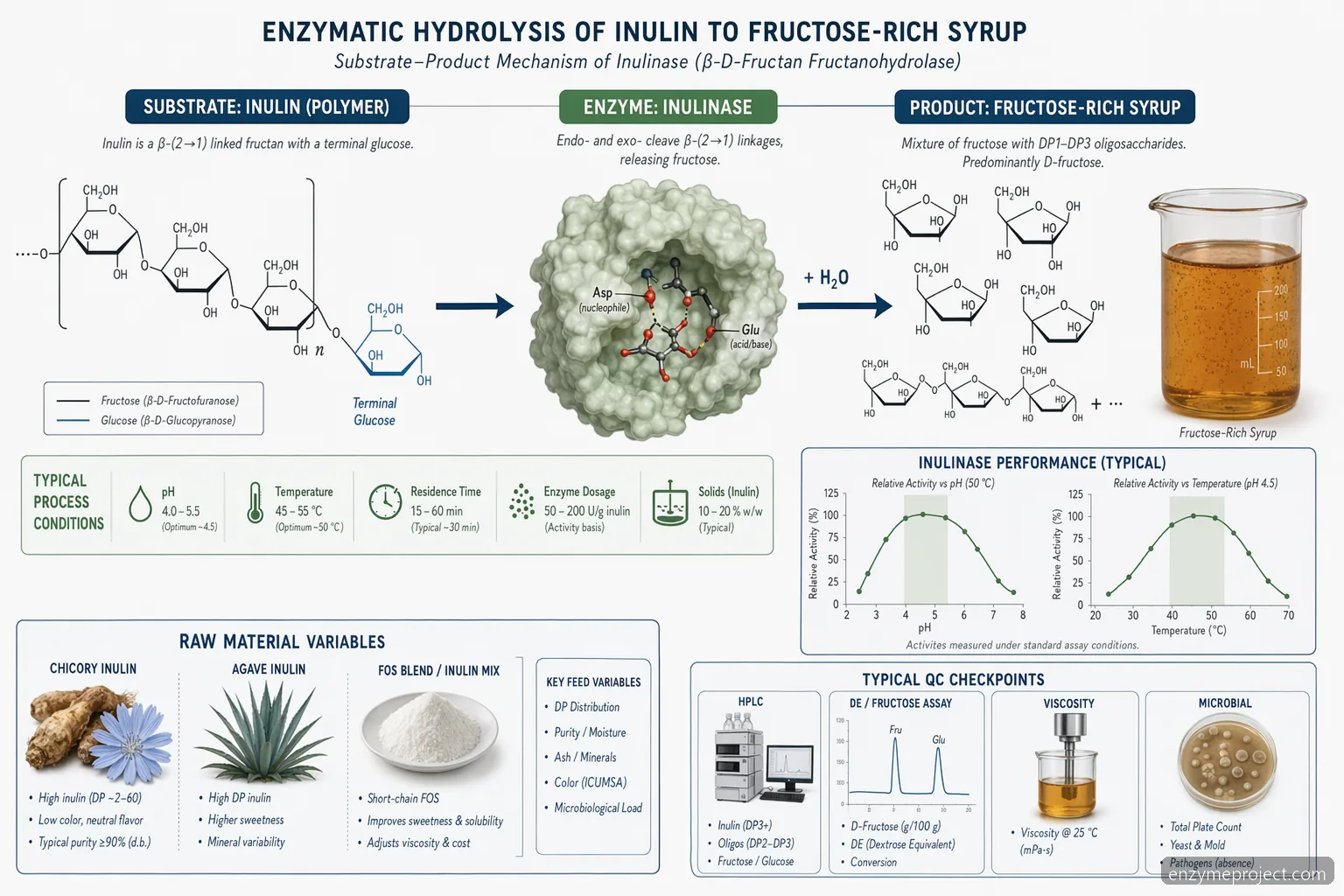
Raw material variables: chicory, agave, and FOS blends
The same inulinase enzyme may behave differently with chicory inulin, agave inulin, and blended inulin with FOS because degree of polymerization, ash, residual sugars, and insoluble matter affect hydrolysis and separation. Chicory root inulin is widely used in food ingredient processing, but suppliers may offer different particle sizes, moisture levels, and FOS content. Agave inulin can present a different fructan profile and may require adjusted residence time or dosage to reach the same fructose target. Buyers should avoid confusing the search phrase “inulin insulin” with the industrial material: inulin is a fructan fiber substrate, while insulin is a hormone and not part of enzyme conversion. For fructose production, the relevant purchasing questions are substrate assay, solubility, fermentable sugar profile, and how the chosen inulinase performs in the actual production water and equipment.
Request substrate COA for moisture, ash, DP profile, and sugar content • Run side-by-side hydrolysis tests on each raw material source • Measure filtration impact as well as fructose yield
QC checks that protect yield and product consistency
A robust inulinase qualification plan should define analytical checkpoints before commercial purchase. Common QC measurements include dry solids, pH, conductivity, soluble sugar profile by HPLC or validated enzymatic method, residual inulin or FOS, color, turbidity, and microbiological status where applicable. During trials, sample at fixed intervals to build a conversion curve rather than relying on a single endpoint. The supplier’s COA should identify activity, lot number, production date or retest date, appearance, and storage recommendations. The TDS should describe activity method, functional pH and temperature ranges, dosage guidance, and compatibility limits. The SDS should support safe handling, storage, and plant risk review. For food sweetener applications, buyers should also confirm that the enzyme preparation meets their internal regulatory and customer documentation requirements without assuming claims that are not supported by supplier paperwork.
Track fructose, glucose, sucrose, residual FOS, and residual inulin • Review COA, TDS, and SDS before pilot purchase • Use conversion curves to set endpoint and dosage
How to qualify an inulinase supplier
For B2B enzyme procurement, the lowest quoted price per kilogram is rarely the best decision metric. A stronger comparison is cost-in-use: enzyme dose, conversion yield, batch time, syrup quality, filtration load, inactivation cost, freight, storage stability, and technical support. Shortlist suppliers that can provide representative samples, transparent activity information, batch-to-batch documentation, and practical scale-up guidance. Ask whether the proposed inulinase is optimized for endo activity, exo activity, or a blend, because the hydrolysis profile can affect fructose release and residual oligosaccharides. Pilot validation should use your inulin powder, plant water, target solids, and downstream process, not only supplier laboratory data. A qualified supplier should help interpret results, recommend an economical dosage band, and support repeat purchases with consistent documentation and supply reliability.
Compare cost per ton of dry substrate processed • Confirm sample availability for lab and pilot validation • Evaluate technical support, logistics, and batch consistency • Document approval criteria before scale-up
Inulinase for Research & Industry
Need Inulinase for your lab or production process?
ISO 9001 certified · Food-grade & research-grade · Ships to 80+ countries
Frequently Asked Questions
What is inulin in an industrial fructose process?
In an industrial process, inulin is a fructan carbohydrate used as a substrate for enzymatic hydrolysis. It may be supplied as inulin powder from chicory root, agave, or other approved botanical sources. Inulinase cleaves fructan linkages to release fructose and shorter sugars. For B2B buyers, the important factors are purity, degree of polymerization, solubility, moisture, residual sugars, and conversion performance under plant conditions.
Is inulin fiber the same as insulin?
No. Inulin fiber is a plant-derived fructan carbohydrate used in food ingredient and sweetener processing. Insulin is a hormone and is unrelated to inulinase hydrolysis. The search phrase “inulin insulin” often reflects spelling confusion. This page addresses industrial conversion of inulin-containing raw materials into fructose-rich syrup and does not provide medical, supplement, or therapeutic advice.
What inulinase dosage should we use for inulin powder?
A useful lab screening range is often 0.1-1.0% enzyme product on dry inulin powder, or an equivalent activity-based dose when the supplier provides activity units. The final dosage depends on substrate source, dry solids, pH, temperature, target fructose yield, and reaction time. Buyers should run conversion curves and calculate cost-in-use before approving a commercial dosage.
Can one inulinase process both chicory root inulin and agave inulin?
Possibly, but it should be confirmed with side-by-side testing. Chicory root inulin and agave inulin can differ in degree of polymerization, FOS content, minerals, particle size, and impurity profile. These differences may change hydrolysis rate, viscosity, filtration, and endpoint sugar profile. Use the same pH, temperature, solids, and enzyme dose in screening to make a fair supplier comparison.
What documents should an inulinase supplier provide?
At minimum, request a COA for the offered lot, a TDS describing activity method and process guidance, and an SDS for safe handling. Depending on your market, you may also need allergen statements, regulatory status documentation, storage and shelf-life data, and traceability information. Do not assume certifications or claims unless they are stated in the supplier’s current documentation.
Request a Wholesale Quote
Manufacturers, ingredient distributors and resellers: send the product or target output, the quantity per order or per month and the destination country to hello@mail.enzymeproject.com; volumes and prices are quoted per order. Request an inulinase sample, COA/TDS/SDS package, and pilot trial support for your inulin powder fructose process. See our application page for Turn inulin into higher-value ingredients at /applications/inulin-vs-psyllium-husk/ for specs, MOQ, and a free 50 g sample.
Contact Us to Contributehello@mail.enzymeproject.com