Organic Inulin Powder: Inulinase Dosage, pH, and Temperature in Fructose Production
Troubleshoot inulinase dosage, pH, temperature, and QC when converting organic inulin powder to fructose for industrial sweeteners.
A practical B2B guide for converting chicory or agave inulin substrates into fructose syrup using industrial inulinase, with process ranges, QC checks, and supplier qualification points.
Buying for production or resale? Request a wholesale quote with the product, the quantity per order or per month and the destination country at hello@mail.enzymeproject.com, or use the quote form on our home page.
Why Organic Inulin Powder Behaves Differently in Hydrolysis
For an industrial buyer, the key question is not only what is inulin, but how a specific inulin powder behaves in a reactor. Inulin is a fructan carbohydrate commonly sourced from chicory root inulin and, in some markets, agave inulin. It contains fructose chains with a terminal glucose, and its average degree of polymerization affects viscosity, solubility, and hydrolysis speed. Organic inulin powder can vary by crop source, extraction method, ash, color, microbial load, and residual mono- or disaccharides. Those differences change how much inulinase enzyme is required to reach a target fructose profile. Do not confuse inulin insulin terminology: inulin is a fiber substrate, while insulin is a hormone and is outside the scope of sweetener processing. In fructose production, treat each lot as a process input requiring COA review and pilot confirmation.
Check source: chicory root, agave, or blended inulin. • Confirm dry solids, moisture, ash, and initial sugar profile. • Measure viscosity at planned processing solids. • Compare lot-to-lot DP distribution when possible.
Inulinase Selection for Fructose from Inulin
Inulinase is the chicory enzyme process workhorse when the goal is fructose from inulin. Exo-inulinase primarily releases fructose units, while endo-inulinase can generate shorter fructooligosaccharides. For food sweetener production, buyers usually need a preparation matched to high fructose yield, acceptable color, low off-odor, and a practical operating window. When processing inulin with FOS, clarify whether the product target is maximum fructose, a defined fructose-FOS balance, or a prebiotic intermediate stream. Enzyme suppliers should disclose activity method, recommended substrate, carrier system, pH range, temperature range, and storage stability in the TDS. The COA should match the delivered batch and include activity, appearance, and relevant microbiological or heavy-metal parameters if supplied. SDS review is also required for handling, PPE, spill response, and warehouse controls before plant trials.
Ask whether activity is reported as INU, IAU, or another assay unit. • Confirm food-processing suitability for the target jurisdiction. • Request sample quantities from the same formulation offered commercially. • Avoid comparing dosage by weight without normalizing activity units.
Starting Dosage, pH, and Temperature Ranges
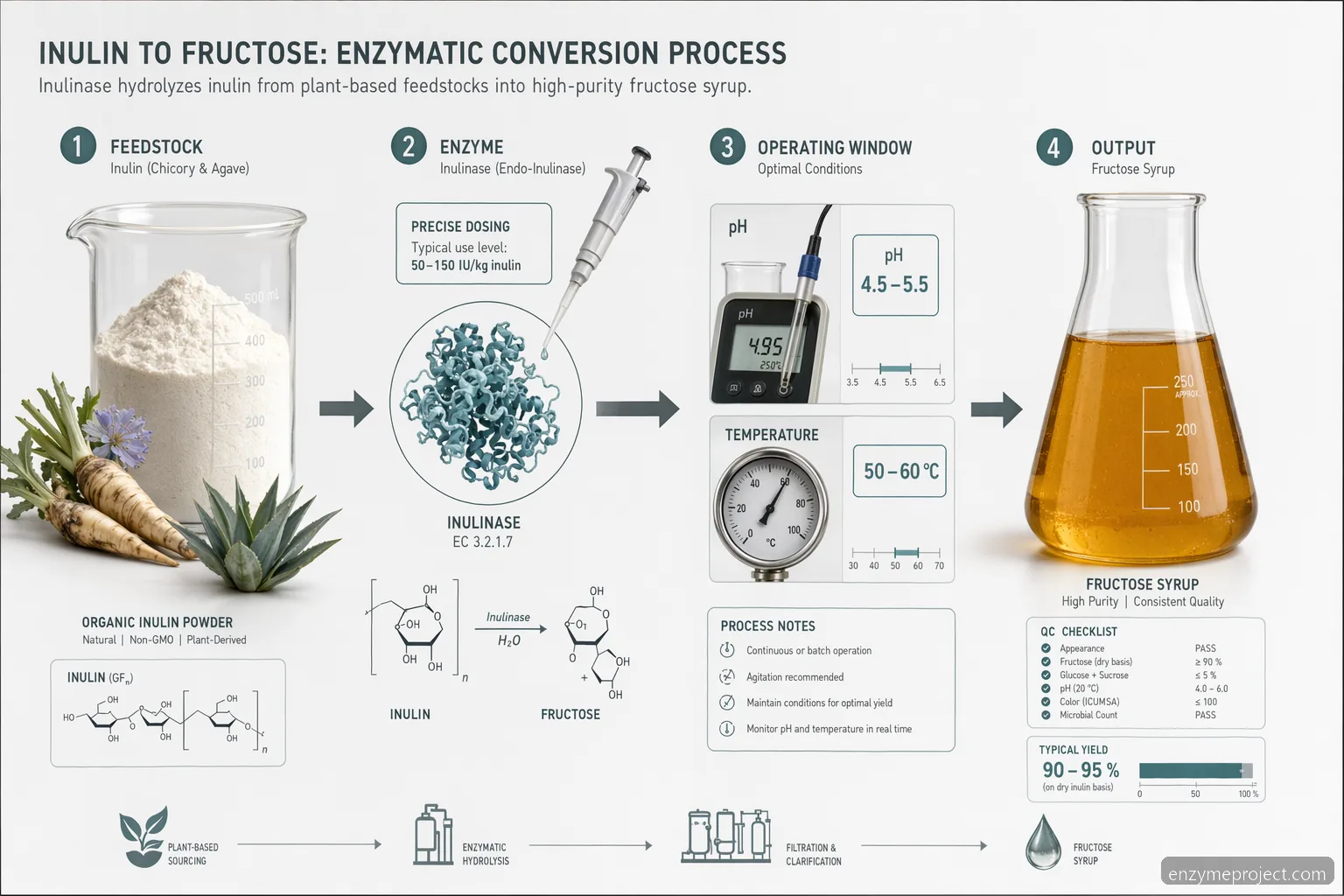
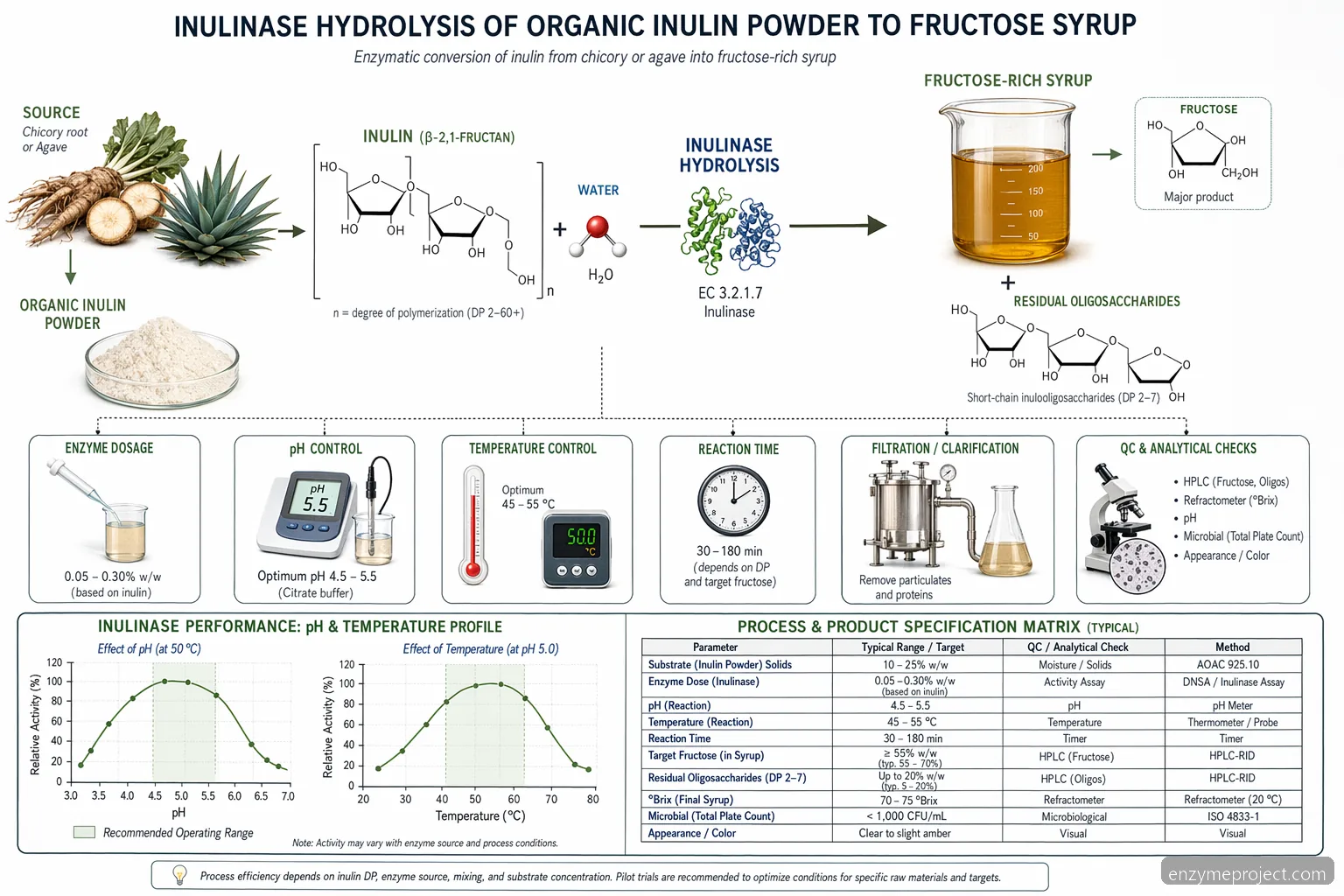
A sensible pilot screen for inulinase enzyme starts with substrate at 10-35% dry solids, depending on mixing and downstream evaporation capacity. Many commercial inulinase systems perform well around pH 4.5-5.5 and 50-60°C, although exact optima are strain and formulation dependent. For dosage, screen a broad band such as 50-500 INU per gram of dry inulin, or approximately 0.05-0.50% w/w commercial enzyme preparation on dry substrate when the supplier recommends weight-based dosing. Run time may range from 4 to 24 hours, with samples taken at fixed intervals for HPLC. If hydrolysis stalls, verify pH drift, calcium or salt effects, microbial contamination, insufficient agitation, enzyme age, and substrate solubility before increasing dosage. Heat inactivation, if required, is commonly evaluated around 80-90°C for 10-20 minutes, subject to product quality constraints.
Do not set final dosage from literature alone. • Optimize against fructose yield per enzyme cost, not fastest reaction only. • Maintain pH control throughout hydrolysis. • Validate enzyme deactivation without damaging color or flavor.
Troubleshooting Low Fructose Yield
Low fructose yield from organic inulin powder is usually a system problem rather than a single enzyme defect. First, verify the raw material: moisture correction errors can make enzyme dosage too low on a true dry basis. Next, confirm that the inulin powder is fully dispersed and hydrated before enzyme addition; undissolved particles reduce contact and can create uneven conversion. Check whether the process pH is measured at reaction temperature or only after cooling, because temperature compensation and probe condition can shift readings. If HPLC shows residual high-DP inulin, increase residence time, improve mixing, or test a higher exo-inulinase load. If FOS accumulates more than expected, the enzyme balance or reaction conditions may not match the target. For unexplained variation, compare fresh enzyme, retained raw material, and a standard reference substrate side by side.
Correct all dosage calculations to dry inulin solids. • Trend fructose, glucose, sucrose, FOS, and residual inulin. • Audit hold times that may allow microbial acid production. • Check CIP residue or sanitizer carryover before enzyme addition.
QC, Supplier Qualification, and Cost-in-Use
For B2B procurement, the lowest enzyme price per kilogram rarely identifies the best inulinase. Cost-in-use should include activity strength, dosage, conversion yield, reaction time, heating or cooling demand, filtration impact, losses during deactivation, and syrup quality. A qualified supplier should provide a current COA, TDS, SDS, shelf-life statement, storage conditions, recommended handling, and a clear change-control process. If the final product is marketed with organic positioning, the buyer must verify whether the enzyme is acceptable as a processing aid under the applicable organic program and customer specification; do not assume compliance from a general food-grade statement. Pilot validation should use representative organic inulin powder lots and plant-like solids, agitation, temperature profile, and water quality. Scale-up criteria should include repeatable HPLC conversion, Brix, pH, color, ash, microbial results, and sensory screening where relevant.
Calculate enzyme cost per metric ton of dry inulin converted. • Document acceptable conversion endpoint and maximum residual FOS. • Set incoming-enzyme release criteria with procurement and QA. • Run at least one hold-time and rework scenario before launch.
Inulinase for Research & Industry
Need Inulinase for your lab or production process?
ISO 9001 certified · Food-grade & research-grade · Ships to 80+ countries
Frequently Asked Questions
What is inulin in a fructose production process?
Inulin is a fructan carbohydrate used as the substrate for enzymatic hydrolysis. In industrial fructose production, inulin powder is dispersed in water and treated with inulinase to release fructose, with some glucose and residual oligosaccharides depending on raw material and enzyme selectivity. The process focus is sugar conversion and syrup quality, not dietary supplement positioning or medical use.
How much inulinase enzyme should be used for organic inulin powder?
A practical pilot starting band is often 50-500 INU per gram of dry inulin, or the supplier’s equivalent weight-based recommendation. Final dosage must be set by HPLC conversion data, reaction time, raw-material solids, and enzyme cost-in-use. Because activity assays differ between suppliers, do not compare products only by kilograms of enzyme preparation per batch.
Is chicory inulin different from agave inulin for hydrolysis?
Yes, it can be different. Chicory inulin and agave inulin may vary in degree of polymerization, native sugar profile, minerals, color, and solubility. Those variables influence viscosity, reaction rate, and the balance of fructose, glucose, FOS, and residual inulin after hydrolysis. Each source should be validated with the same inulinase, pH, temperature, and analytical method planned for production.
What QC method confirms fructose from inulin conversion?
HPLC is commonly used to quantify fructose, glucose, sucrose, FOS, and residual inulin fractions where the method is suitable. In-process Brix and pH are useful controls, but they cannot prove conversion profile alone. For supplier qualification, align the analytical method, sampling time, sample deactivation step, and acceptance criteria before comparing enzyme lots or changing inulin powder suppliers.
Can an inulinase be used in an organic-positioned sweetener process?
Possibly, but it must be verified against the applicable organic program, customer specification, and processing-aid rules. Buyers should request the enzyme COA, TDS, SDS, composition disclosure as appropriate, and any relevant statements from the supplier. Avoid assuming that food-grade status automatically satisfies organic requirements. QA, regulatory, and the customer should approve the enzyme before commercial production.
Request a Wholesale Quote
Manufacturers, ingredient distributors and resellers: send the product or target output, the quantity per order or per month and the destination country to hello@mail.enzymeproject.com; volumes and prices are quoted per order. Send your inulin powder COA and target fructose specification to enzymeproject.com for inulinase pilot guidance and cost-in-use evaluation. See our application page for Turn inulin into higher-value ingredients at /applications/inulin-vs-psyllium-husk/ for specs, MOQ, and a free 50 g sample.
Contact Us to Contributehello@mail.enzymeproject.com