What Is Inulin: Inulinase Supplier Guide for Fructose Production
Learn what inulin is and how industrial inulinase converts chicory or agave inulin into fructose syrup, with process, QC, and supplier tips.
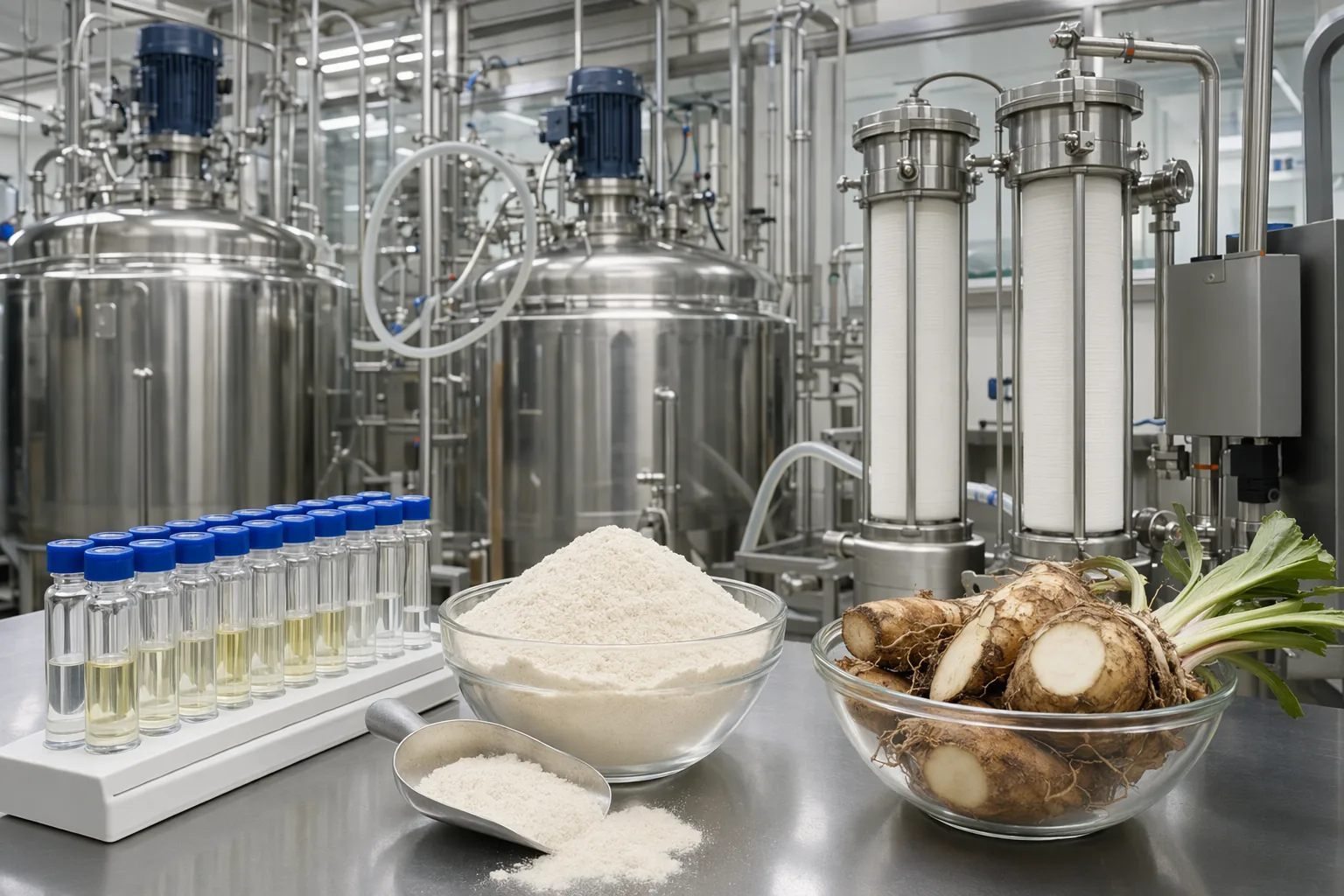
For food and ingredient manufacturers, inulin is more than a dietary fiber label claim. It is a fructan feedstock that can be hydrolyzed with inulinase to produce fructose-rich syrups from chicory, agave, and other plant sources.
Buying for production or resale? Request a wholesale quote with the product, the quantity per order or per month and the destination country at hello@mail.enzymeproject.com, or use the quote form on our home page.
What Is Inulin in Industrial Ingredient Processing?
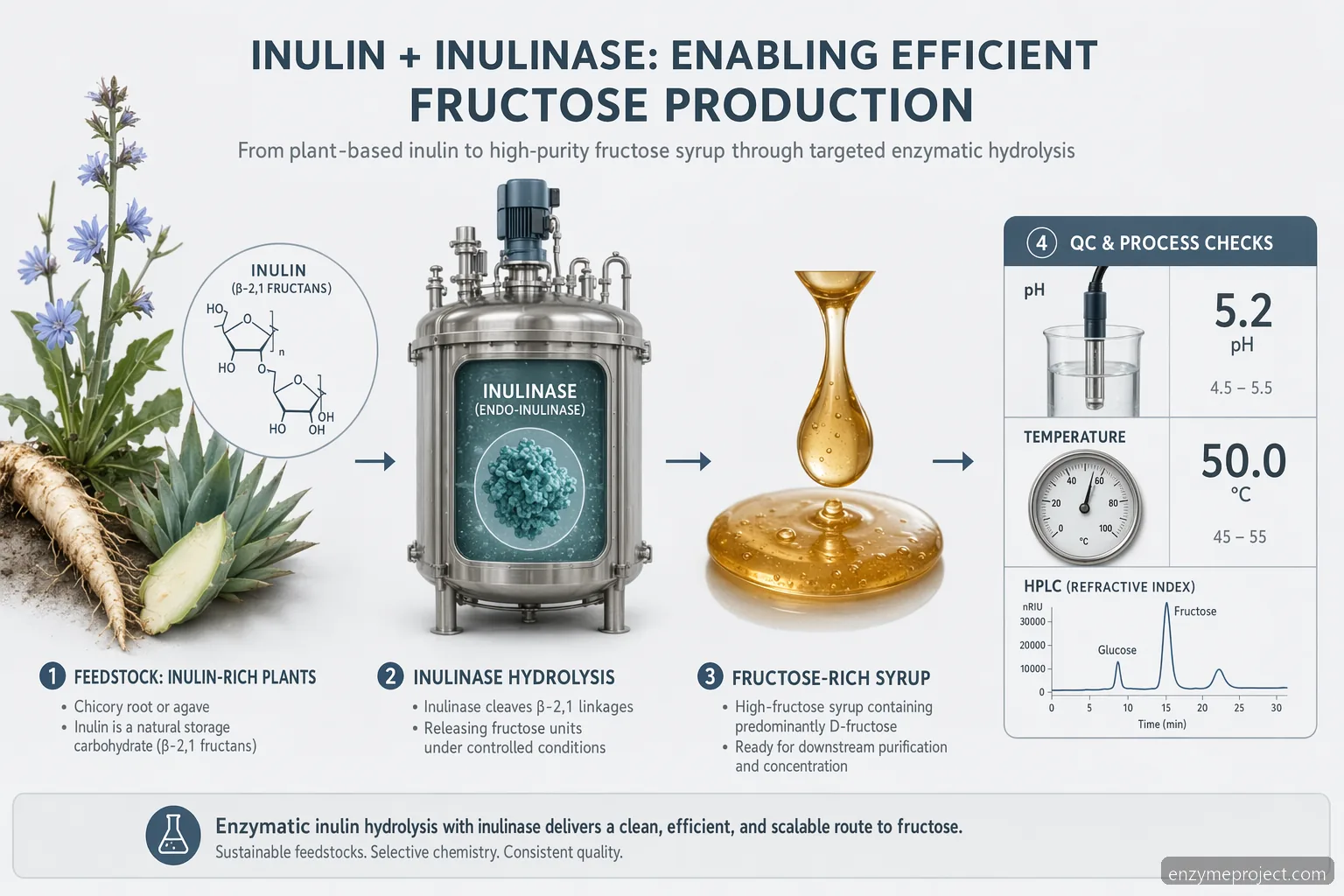
What is inulin? In industrial terms, inulin is a storage carbohydrate made mainly of fructose units linked through beta-2,1 bonds, often ending with a glucose unit. It occurs naturally in chicory root, agave, Jerusalem artichoke, and other botanical sources. Commercial inulin powder is typically used as inulin fiber, a prebiotic ingredient, or a feedstock for enzymatic conversion. For buyers searching “inulin what is it,” the important distinction is that inulin is not insulin; the phrase “inulin insulin” reflects a common spelling confusion, not a functional equivalence. In fructose production, the value of chicory inulin or agave inulin depends on dry solids, degree of polymerization, ash, color, and how easily it can be solubilized and hydrolyzed. These parameters influence enzyme dosage, throughput, filtration, syrup purity, and total cost-in-use.
Common feedstocks: chicory root inulin, agave inulin, and inulin with FOS fractions. • Typical commercial forms: inulin powder, slurry, extract, or concentrated solution. • Key feedstock variables: DP profile, dry solids, color, ash, minerals, and microbial load.
How Inulinase Converts Inulin to Fructose
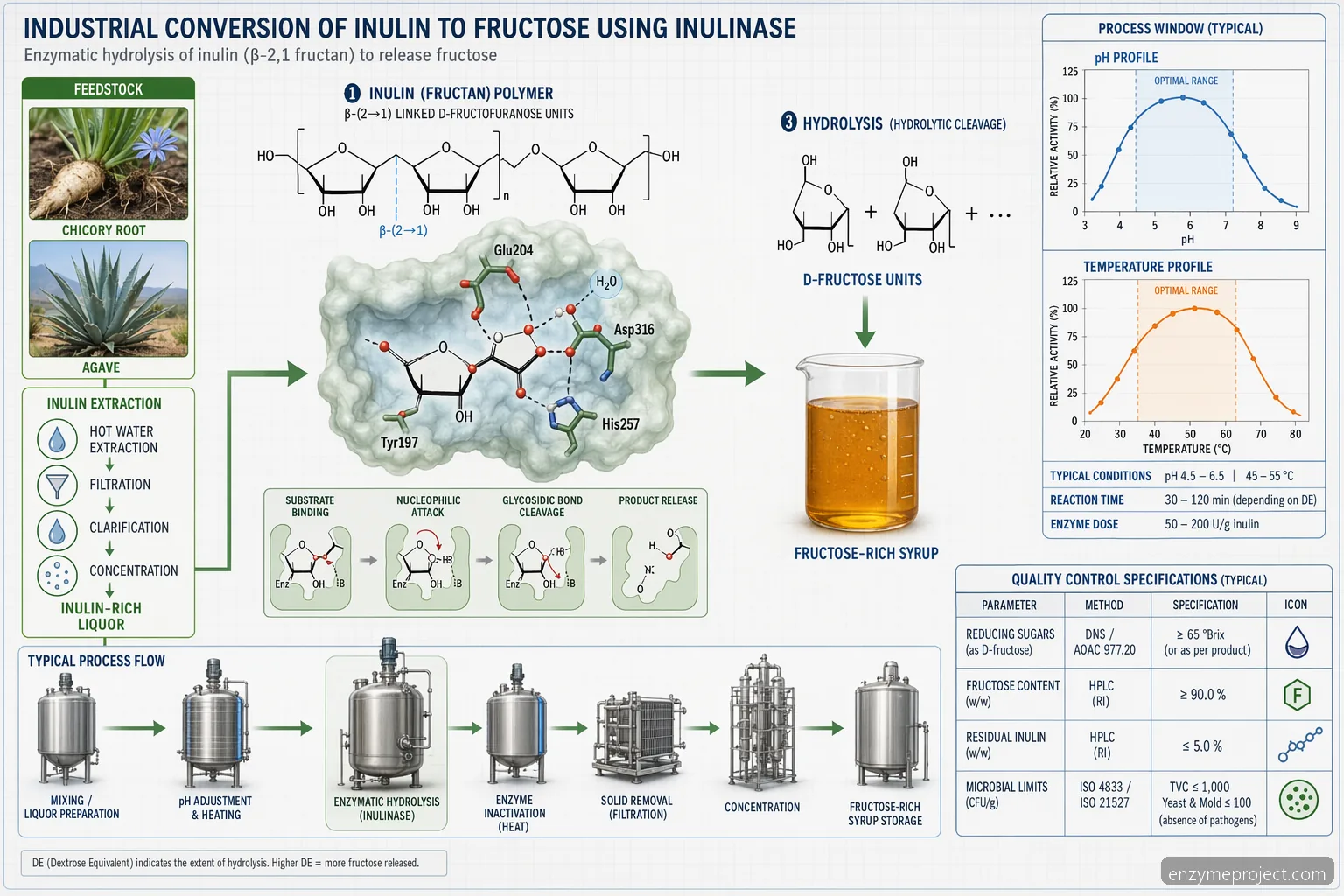
Inulinase enzyme catalyzes hydrolysis of inulin’s fructosyl linkages, producing fructose, glucose, sucrose traces, and shorter fructooligosaccharides depending on enzyme type and reaction endpoint. Exo-inulinase tends to release terminal fructose units and is preferred for high fructose yield, while endo-inulinase cuts internal chains and can help reduce viscosity or produce FOS-rich profiles. For fructose production, suppliers usually optimize enzyme blends for high conversion, predictable residence time, and compatibility with acidic food-processing conditions. A typical starting window is pH 4.5 to 5.5 and 50 to 60°C, but the selected inulinase should be validated against the actual substrate and plant constraints. Temperature stability, calcium sensitivity, preservative carryover, and soluble solids level can all change performance. A qualified enzyme supplier should provide clear activity definitions and application guidance, not only a product name.
Use exo-inulinase focus when maximum fructose release is the target. • Use endo activity strategically when viscosity reduction or FOS control is needed. • Confirm activity units and assay conditions before comparing supplier quotes.
Recommended Process Window for Pilot Trials
A practical pilot protocol begins by dissolving or dispersing inulin powder at the target dry solids, commonly 15 to 35% depending on viscosity, mixing capacity, and filtration design. Adjust pH before enzyme addition, then heat to the chosen reaction temperature after confirming enzyme stability. Many inulinase enzyme systems perform well around pH 4.8 to 5.2 and 52 to 58°C, with reaction times from 4 to 24 hours depending on substrate DP, dosage, and required conversion. A safe screening dosage band is often 0.2 to 2.0 kg enzyme preparation per metric ton of dry inulin solids, or the equivalent activity-based dose provided by the supplier. Do not lock the dosage from literature alone; run a time-course with HPLC sugar profiling. End the reaction by heat inactivation or downstream pH and temperature shift according to your product design and food safety plan.
Screen at three dosages and at least four time points. • Track viscosity and filtration rate, not only fructose yield. • Use plant water, real substrate, and intended Brix when possible. • Verify enzyme inactivation conditions before commercial scale-up.
QC Checks for Fructose Production from Inulin
Quality control should connect enzyme performance with finished syrup specifications. HPLC is the most useful routine method for fructose, glucose, sucrose, residual FOS, and remaining higher-DP inulin fragments. Depending on the process, reducing sugar, Brix, pH, conductivity, color, turbidity, ash, and microbial counts may also be required. For chicory enzyme applications, mineral load and plant-derived color can affect downstream decolorization or ion exchange cost. If the feed is inulin with FOS, define whether FOS is a desired co-product, a partial-conversion intermediate, or a residual impurity. Buyers should ask suppliers for TDS guidance on pH, temperature, activity, storage, and compatibility, plus a COA for each batch and an SDS for safe handling. During pilot validation, calculate cost-in-use as enzyme cost per kilogram of target fructose at required purity, not simply price per kilogram of enzyme.
Primary assay: HPLC sugar profile and residual DP distribution. • Process checks: pH, Brix, viscosity, filtration rate, color, and turbidity. • Commercial checks: batch COA match, activity retention, and storage stability.
How to Qualify an Inulinase Supplier
A strong inulinase supplier should support both enzyme selection and process economics. Request a current TDS, SDS, representative COA, recommended storage conditions, shelf-life guidance, allergen or production-origin statements if needed for your market, and activity assay details. For B2B purchasing, the critical question is not only whether the enzyme works, but whether it works reproducibly with your chicory inulin, agave inulin, or mixed inulin powder supply. Ask for pilot quantities, sample handling instructions, and support for data review after your trials. Supplier qualification should include batch-to-batch consistency, lead time, packaging options, documentation responsiveness, and change-control communication. Avoid relying on broad claims such as “high conversion” without conversion curves, substrate conditions, and analytical methods. The best procurement decision combines technical fit, cost-in-use, documentation quality, and supply reliability.
Request COA, TDS, SDS, activity method, and recommended process window. • Run pilot trials with your real feedstock and plant water. • Compare suppliers by cost per converted dry solid or kilogram of fructose. • Confirm logistics, packaging, shelf life, and documentation response time.
Inulinase for Research & Industry
Need Inulinase for your lab or production process?
ISO 9001 certified · Food-grade & research-grade · Ships to 80+ countries
Frequently Asked Questions
What is inulin, and why is it used for fructose production?
Inulin is a fructose-based carbohydrate found in plants such as chicory and agave. Industrial processors use chicory root inulin, agave inulin, or inulin powder as a feedstock because the polymer can be hydrolyzed into fructose. With the right inulinase enzyme, manufacturers can convert soluble inulin and FOS fractions into fructose-rich streams for food sweetener applications.
Is inulin the same as insulin?
No. Inulin and insulin are different substances. Inulin is a plant-derived fructan used as inulin fiber, prebiotic ingredient, or enzymatic feedstock. Insulin is a hormone and is not relevant to industrial fructose syrup production. For B2B enzyme selection, the focus should be inulin source, degree of polymerization, dry solids, and conversion performance with inulinase.
What process conditions should we test for inulinase?
A reasonable pilot starting point is pH 4.5 to 5.5, 50 to 60°C, and 15 to 35% dry solids, adjusted for viscosity and equipment limits. Screen several enzyme dosages, such as 0.2 to 2.0 kg per metric ton of dry inulin solids, or an activity-based dose from the supplier. Confirm results by HPLC, not only by Brix or reducing sugar.
How do we compare inulinase suppliers?
Compare suppliers using real substrate trials, not catalog claims alone. Request COA, TDS, SDS, activity assay details, storage guidance, and pilot samples. Measure fructose yield, residual FOS or inulin, reaction time, viscosity, filtration rate, and downstream purification impact. A lower enzyme price may not be lower cost-in-use if it requires higher dosage, longer holding time, or more purification.
Can the same inulinase process handle chicory inulin and agave inulin?
Often yes, but it should be validated. Chicory inulin and agave inulin can differ in DP distribution, ash, color, minerals, and FOS content. These differences affect solubility, viscosity, reaction speed, and purification requirements. Run side-by-side pilot trials under the same pH, temperature, and dosage conditions, then optimize for the feedstock most representative of commercial supply.
Request a Wholesale Quote
Manufacturers, ingredient distributors and resellers: send the product or target output, the quantity per order or per month and the destination country to hello@mail.enzymeproject.com; volumes and prices are quoted per order. Request an inulinase TDS, COA, SDS, and pilot sample to validate fructose production with your inulin feedstock. See our application page for Turn inulin into higher-value ingredients at /applications/inulin-vs-psyllium-husk/ for specs, MOQ, and a free 50 g sample.
Contact Us to Contributehello@mail.enzymeproject.com