Inulin With FOS Powder: Inulinase Specification Checklist for Fructose Production
Compare inulin and FOS feedstocks and specify inulinase enzyme for controlled fructose production, QC, pilot trials, and supplier qualification.
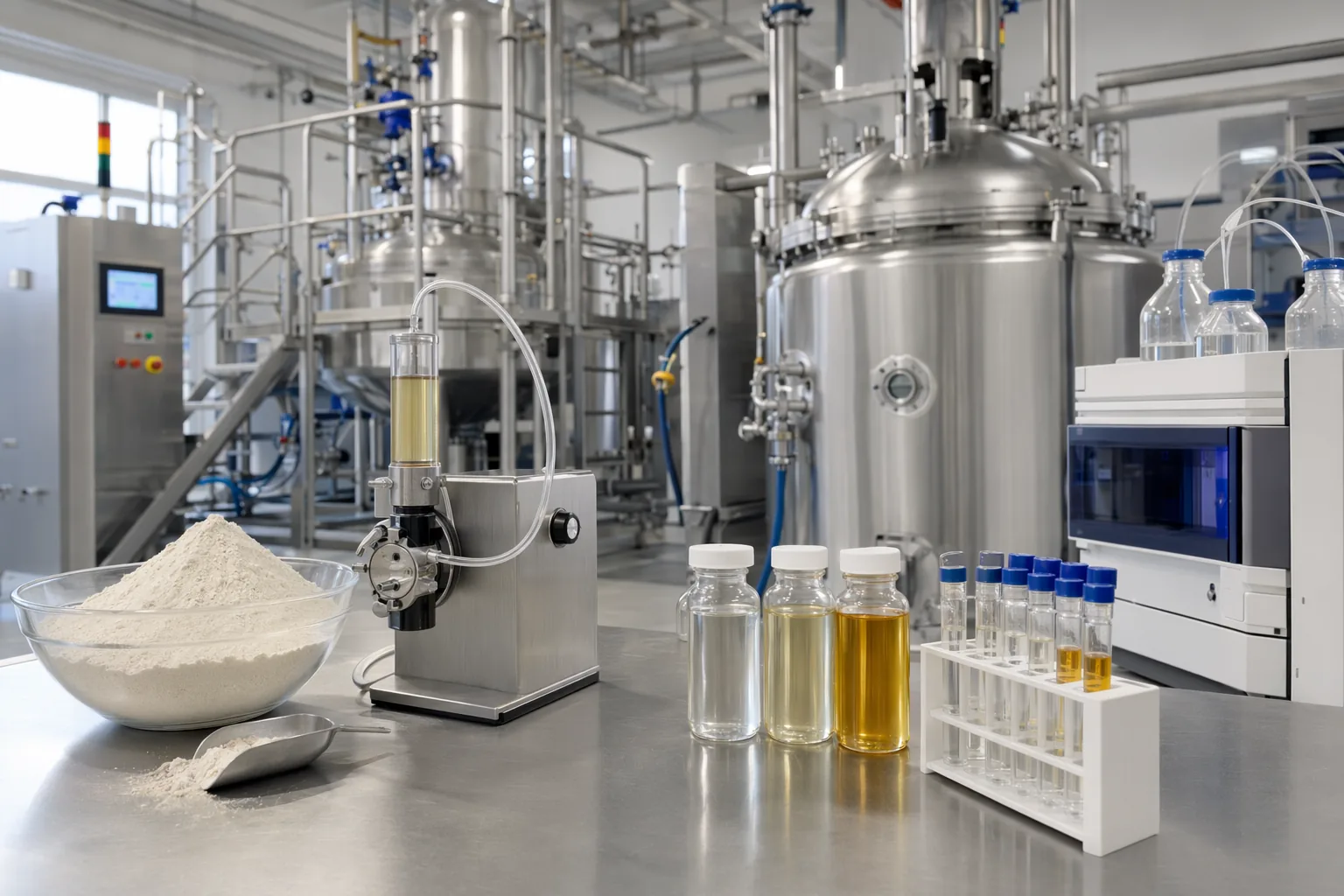
For manufacturers converting chicory, agave or other inulin-rich materials into fructose syrup, and for distributors who resell inulinase to them, enzyme choice should follow the substrate profile, process fit, analytical control and cost-in-use. Buying for production or resale? Request a wholesale quote with the product, the quantity per order or per month and the destination country at hello@mail.enzymeproject.com, or use the quote form on our home page.
Why inulin with FOS powder needs enzyme-specific evaluation
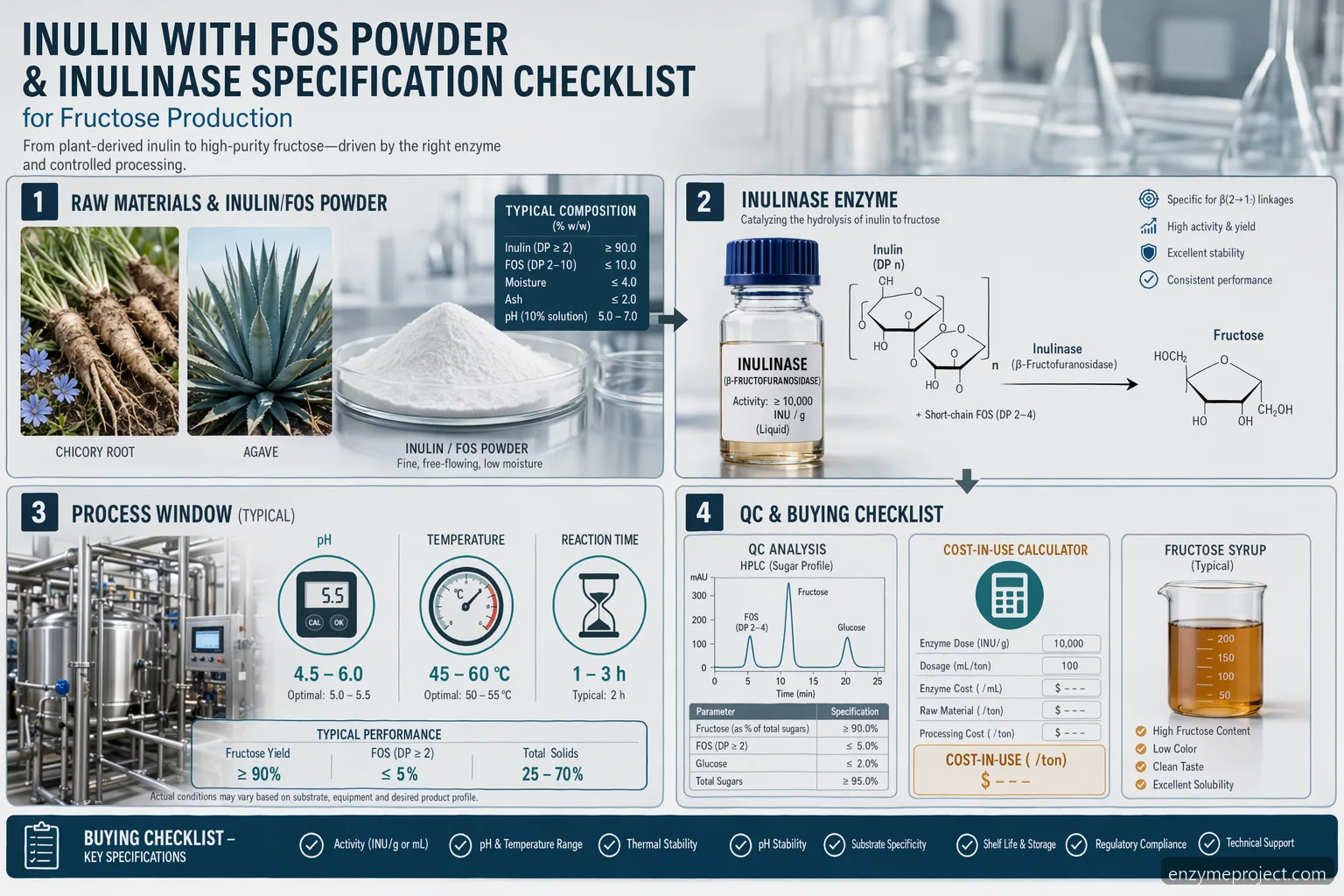
Inulin with FOS powder can describe a wide range of carbohydrate profiles, from long-chain chicory inulin to shorter fructo-oligosaccharides generated by partial hydrolysis. For fructose production, that difference changes enzyme demand, reaction time, viscosity, and final sugar distribution. A buyer comparing inulin powder, chicory inulin, chicory root inulin, or agave inulin should avoid treating them as equivalent inputs. Chain length, ash, moisture, residual glucose or sucrose, color, and insoluble matter all affect the performance of an inulinase enzyme. The goal is not to answer supplement questions such as what is inulin or inulin fiber benefits, but to define a controlled industrial substrate. If procurement is also seeing search terms such as inulin insulin, clarify internally that inulin is a fructan carbohydrate, while insulin is a hormone; they are unrelated for enzyme processing.
Compare DP distribution, moisture, ash, and insoluble matter before enzyme trials. • Separate nutritional terminology from production specifications. • Use carbohydrate profiling rather than label descriptions alone.
Choose the right inulinase activity for fructose release
Industrial inulinase products may contain mainly exo-inulinase activity, endo-inulinase activity, or a blend. For fructose from inulin, exo-inulinase is typically prioritized because it releases fructose units from fructan chains. Endo-inulinase can reduce polymer length and viscosity, but excessive random cleavage may leave a higher FOS fraction if the process is not driven to completion. Buyers should ask how activity is defined, what substrate was used in the assay, and whether the reported unit value translates to their own inulin with FOS powder. A high activity number is less useful than predictable conversion under plant conditions. Compare enzyme candidates at the same dry solids, pH, temperature, contact time, and feedstock lot. For food sweetener operations, also confirm whether the enzyme preparation fits the intended processing and regulatory review pathway in the target market.
Prioritize exo-inulinase for high fructose release. • Use endo-inulinase strategically when viscosity reduction is needed. • Do not compare activity units unless assay methods are understood.
Recommended process window for pilot trials
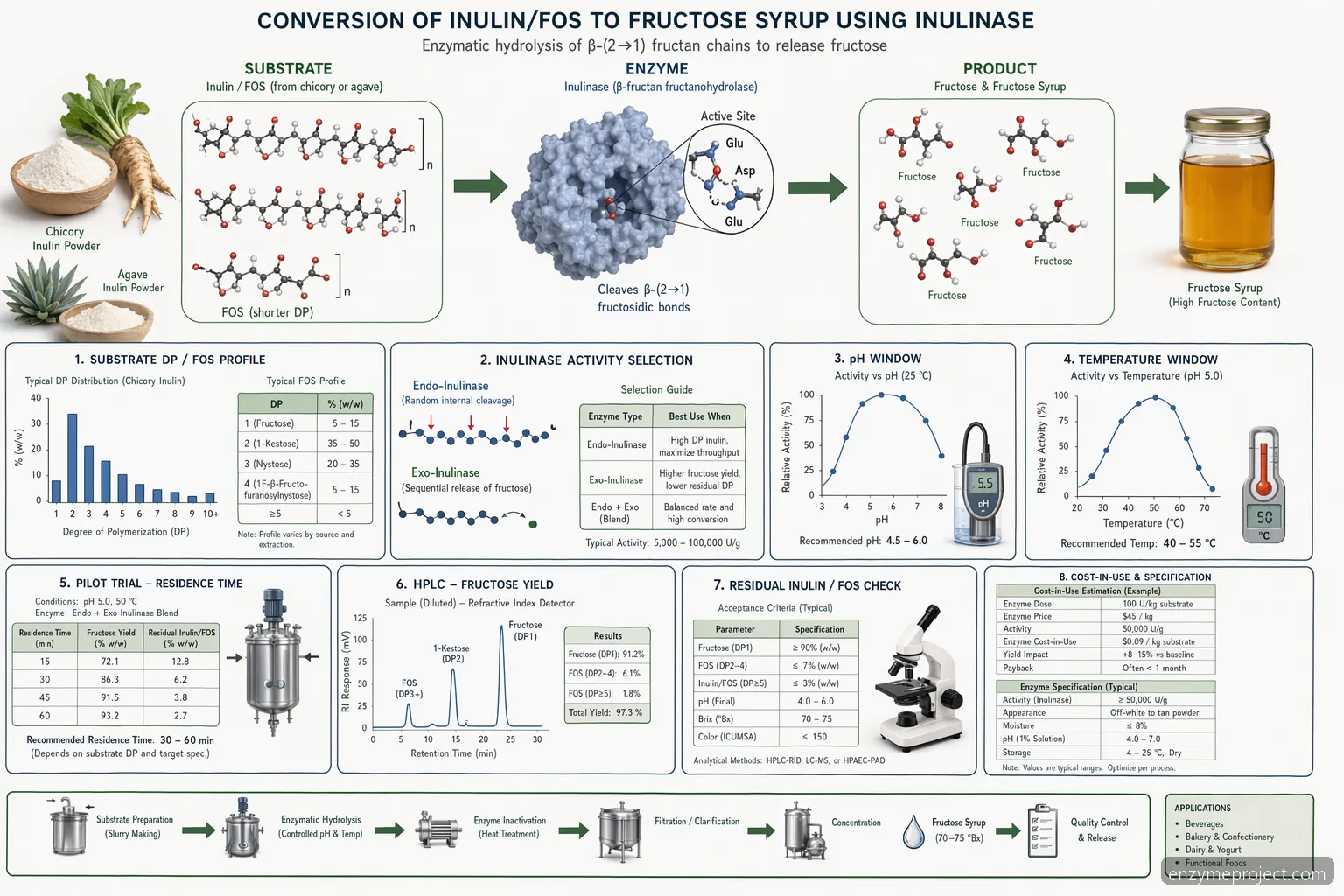
A practical pilot trial should begin with the enzyme supplier’s TDS, then bracket conditions around the plant’s heating, holding, and pH control limits. Many commercial inulinase processes are evaluated around pH 4.0 to 5.5 and 45 to 60 degrees Celsius, but the exact optimum depends on enzyme source and formulation. Initial dosage screening may start around 0.1% to 1.0% enzyme preparation on substrate dry solids, then narrow based on conversion rate and cost-in-use. Run at least three time points, such as 4, 8, and 16 hours, to model yield versus tank occupancy. For higher dry solids, watch viscosity, mixing efficiency, localized pH shifts, and microbial control. Include a heat-inactivation or downstream separation step only after confirming that it does not create color, off-flavor risk, or filtration bottlenecks.
Screen pH 4.0-5.5 and 45-60°C unless the TDS states otherwise. • Start dosage trials around 0.1-1.0% on dry solids. • Measure conversion over time, not only at the final endpoint.
QC checks that matter for fructose production
Quality control should connect enzyme performance to commercial output, not just laboratory conversion. HPLC carbohydrate analysis is commonly used to quantify fructose, glucose, sucrose, residual FOS, and remaining inulin. Refractometer dry solids, pH, conductivity, color, turbidity, and ash help explain process variability between inulin powder lots. If the plant uses chicory enzyme processing or agave inulin as alternate feedstocks, each source should be qualified separately because mineral load and chain length can shift reaction kinetics. Microbial limits and bioburden controls are important when hydrolysis is conducted at moderate temperatures for extended holding times. For syrup applications, compare final sweetness profile and fermentable sugar distribution against the customer specification. Retain samples from feedstock, hydrolysate, and clarified product so deviations can be traced to raw material, enzyme, or process conditions.
Use HPLC for fructose, glucose, sucrose, FOS, and residual inulin. • Track pH, dry solids, color, turbidity, ash, and conductivity. • Qualify each feedstock source separately.
Supplier qualification and cost-in-use comparison
For B2B enzyme procurement, the lowest price per kilogram rarely predicts the lowest production cost. Compare inulinase candidates by cost per metric ton of inulin solids converted, cost per kilogram of fructose produced, yield consistency, filtration impact, storage stability, and support during scale-up. Request a current COA for the offered batch, a TDS with activity definition and operating guidance, and an SDS for handling and safety review. Supplier qualification should also cover batch traceability, packaging size, lead time, change notification practices, allergen or carrier information where relevant, and technical response capability. Before committing to a production contract, run a pilot validation using the actual inulin with FOS powder, water quality, pH adjustment chemicals, heat profile, and downstream equipment. The best supplier is the one that helps reduce yield risk, not just enzyme purchase price.
Compare cost per kilogram of fructose, not enzyme price alone. • Request COA, TDS, SDS, and batch traceability. • Validate with actual plant feedstock and equipment.
Inulinase for Research & Industry
Need Inulinase for your lab or production process?
ISO 9001 certified · Food-grade & research-grade · Ships to 80+ countries
Frequently Asked Questions
Is inulin with FOS powder the same as inulin powder for enzyme processing?
Not necessarily. Inulin powder may contain longer fructan chains, while inulin with FOS powder can include a larger short-chain fraction. This affects viscosity, reaction rate, and the amount of fructose that inulinase can release under a given process window. Industrial buyers should compare carbohydrate profiles by HPLC or equivalent analysis rather than relying only on product descriptions.
Which enzyme is best for producing fructose from inulin?
For high fructose production, buyers usually prioritize inulinase preparations with strong exo-inulinase activity because they release fructose from fructan chains. Endo-inulinase activity may help reduce viscosity or shorten chains, but it can also leave more FOS if hydrolysis is incomplete. The best option should be selected through pilot trials using the actual substrate and process conditions.
What process conditions should be tested first?
A practical first screen is often pH 4.0-5.5, 45-60°C, and 0.1-1.0% enzyme preparation on substrate dry solids, adjusted according to the supplier TDS. Test multiple time points and monitor fructose formation, residual inulin, FOS, pH drift, color, and filtration. The final setting should balance conversion yield, tank time, product quality, and enzyme cost-in-use.
What documents should an inulinase supplier provide?
Request a COA for batch-specific quality, a TDS for activity definition and recommended conditions, and an SDS for handling and safety review. For supplier qualification, also ask about batch traceability, storage requirements, shelf-life, packaging, lead time, change notification, and technical support. These documents help procurement, QA, and process engineering evaluate risk before scale-up.
Request a Wholesale Quote
Manufacturers, ingredient distributors and resellers: send the product or target output, the quantity per order or per month and the destination country to hello@mail.enzymeproject.com; volumes and prices are quoted per order. Share your inulin or FOS feedstock profile to request an inulinase pilot trial plan, documentation package, and cost-in-use comparison. See our application page for Turn inulin into higher-value ingredients at /applications/inulin-vs-psyllium-husk/ for specs, MOQ, and a free 50 g sample.
Contact Us to Contributehello@mail.enzymeproject.com