Inulin With FOS: Choosing the Enzyme Route for Prebiotic Ingredients
For prebiotic ingredient manufacturers and resellers: how inulin with FOS is made from inulin, how it differs from sucrose-based FOS, and what to send for an inulinase quote.
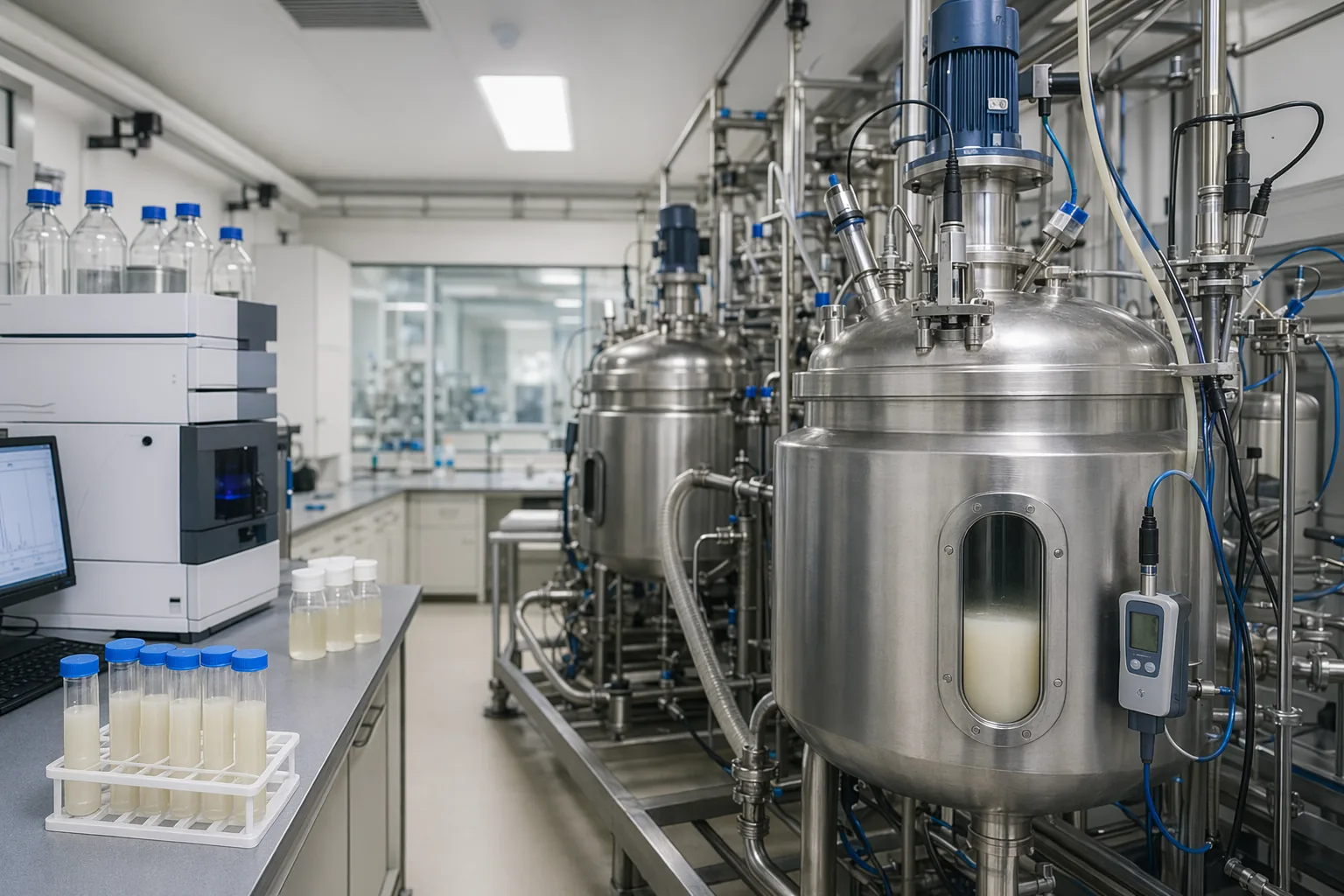
Prebiotic ingredient makers can reach FOS by two industrial routes: shortening inulin from chicory, agave or Jerusalem artichoke with inulinase, or building FOS from sucrose with a fructosyltransferase. The route decides the chain-length spectrum, the purification load and which enzyme you buy. This guide is for manufacturers and resellers who need to specify inulin with FOS, or the inulinase that makes it, for production. Buying for production or resale? Request a wholesale quote with the product, the quantity per order or per month and the destination country at hello@mail.enzymeproject.com, or use the quote form on our home page.
What Is Inulin With FOS in a Processing Context?
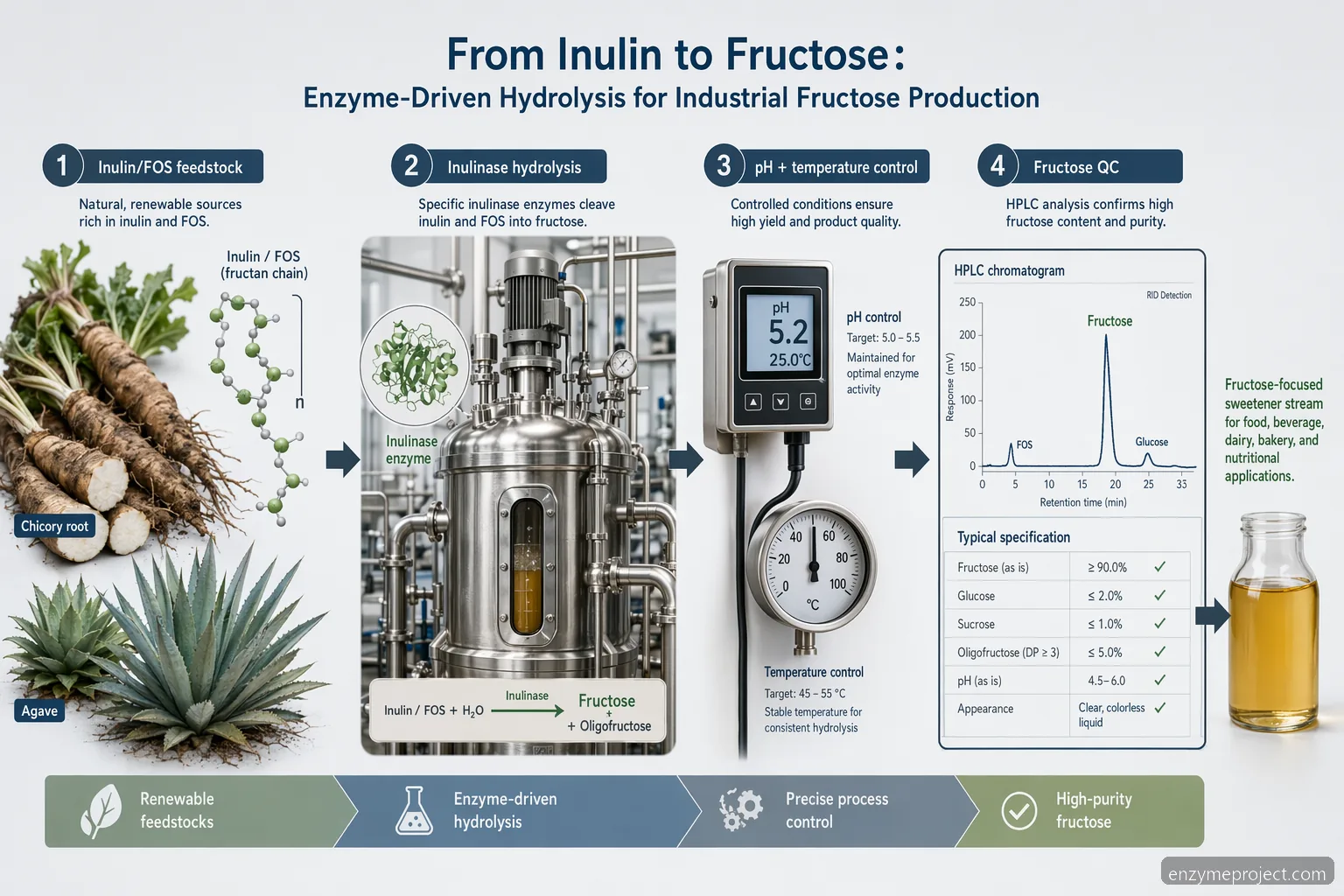
For an industrial processor asking what is inulin, the relevant answer is a fructan carbohydrate feedstock, usually extracted as inulin powder from chicory root, agave, Jerusalem artichoke, or similar botanical sources. Inulin fiber is built mainly from beta-2,1-linked fructose units with a terminal glucose, while FOS, or fructooligosaccharides, are shorter-chain fractions. The phrase inulin with FOS typically describes a mixed degree-of-polymerization substrate that can be hydrolyzed to release fructose. Chicory inulin and chicory root inulin are common commercial inputs because they offer consistent supply and established extraction routes; agave inulin may require separate validation due to different impurity and DP profiles. This application is not about supplement dosing or medical advice. The search phrase inulin insulin often reflects confusion: inulin is a carbohydrate ingredient, while insulin is a hormone. Enzymeproject focuses on enzyme-enabled conversion economics, process control, and ingredient manufacturing.
Main substrate: inulin and FOS fructans • Main enzyme: inulinase enzyme • Main output: fructose-rich hydrolysate • Main market: food sweetener and prebiotic processing
Two Routes to FOS: Partial Inulin Hydrolysis or Sucrose Transfer
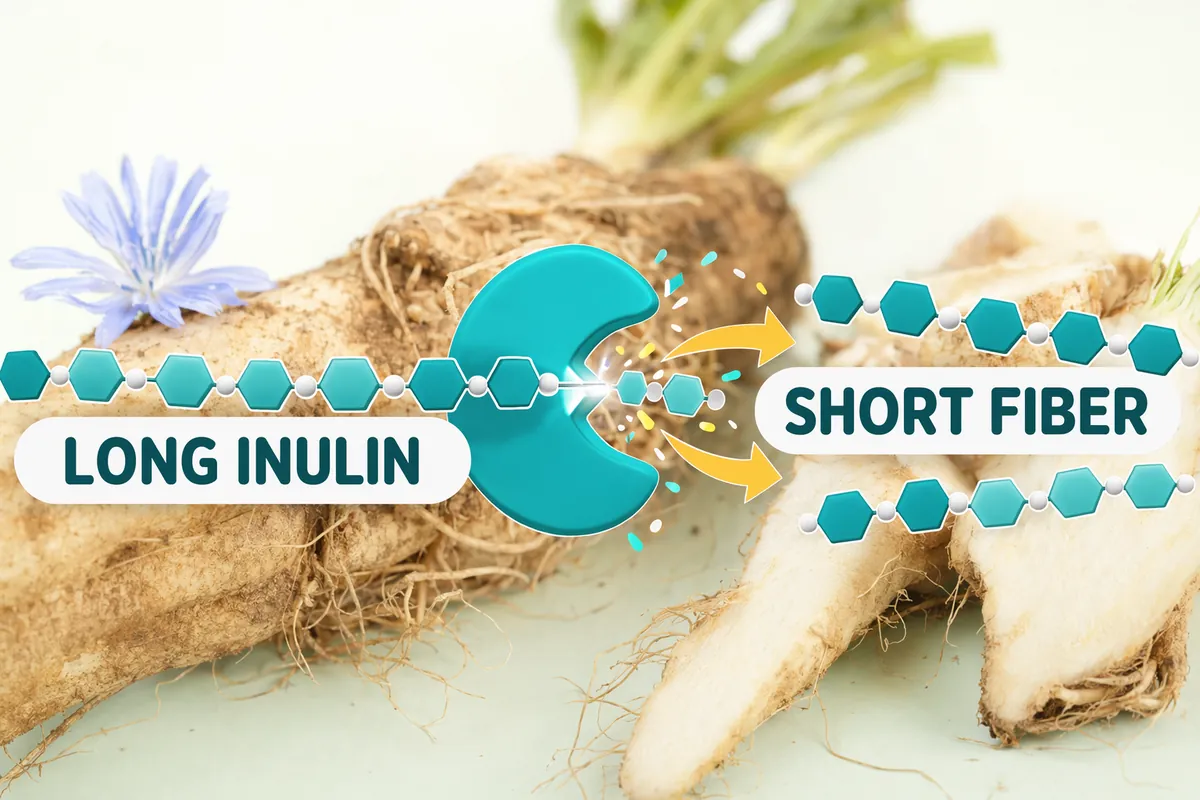
Inulin with FOS comes from the inulin route. Endo-inulinase cuts long inulin chains from chicory or agave into shorter fructo-oligosaccharides, and exo-inulinase, if the reaction is driven further, releases free fructose. The other industrial route starts from sucrose: a fructosyltransferase moves fructose units onto sucrose and builds FOS whose main products are GF2, GF3 and GF4, the short chains known as kestose, nystose and fructofuranosylnystose. Sucrose-route plants run at high sugar concentration and have to keep the transfer reaction ahead of plain hydrolysis, because hydrolysis turns the feed into unwanted glucose and fructose instead of FOS. How pure the sucrose-route product gets depends mainly on downstream purification: ion exchange, membrane separation or chromatography.
For a buyer this changes the specification. An inulin-derived FOS powder carries a broader chain-length mix inherited from the plant inulin, while sucrose-derived FOS is a narrow GF2 to GF4 spectrum whose purity is set by the purification step. Ask your supplier which route made the product, what the chain-length spectrum is and which purification step was used, and compare inulinase offers on the spectrum they deliver from your own inulin.
Inulinase is widely used in FOS production, where it is sold as a high added-value process enzyme, and its listings name food, beverage, dairy and pharmaceutical applications. Industrial inulinase is sold in 25 kg drums; we also supply 1 kg and 5 kg packs for trials and resale.
Inulin route: inulinase shortens plant inulin into a mixed FOS profile • Sucrose route: fructosyltransferase builds GF2 to GF4 from sucrose • Purity in the sucrose route is set by purification • Ask which route, which spectrum, which purification step
How Inulinase Converts Inulin and FOS to Fructose
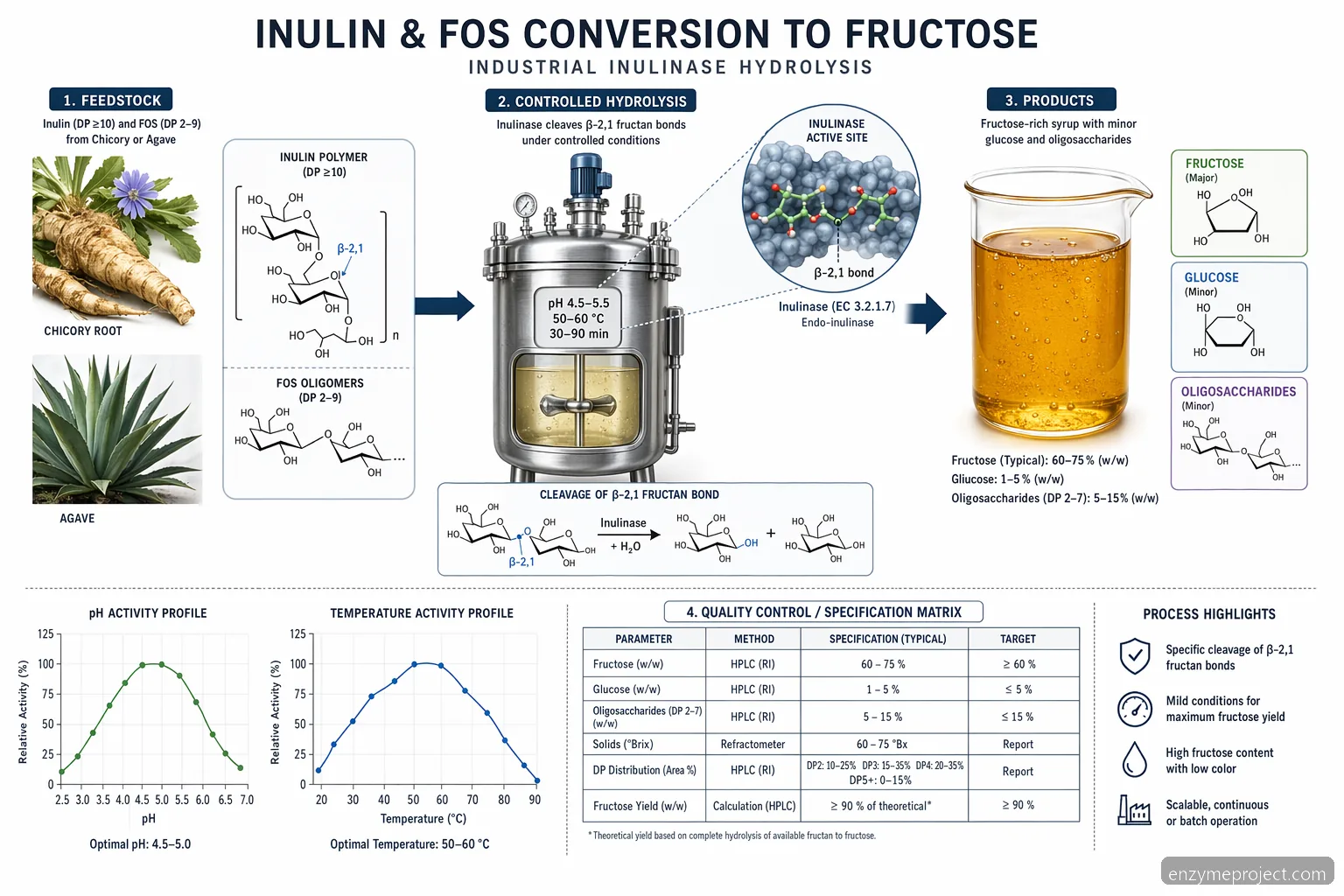
Inulinase hydrolyzes fructan linkages in inulin with FOS, producing fructose, glucose traces from terminal residues, sucrose-related fractions, and residual oligosaccharides depending on conversion target. Exo-inulinase is typically favored when the goal is high fructose release, while endo-inulinase may be useful where controlled chain shortening or prebiotic processing is desired. For fructose production, processors usually screen enzyme activity against real plant extract or dissolved inulin powder rather than relying only on model substrates. Practical variables include dry solids, viscosity, calcium or mineral load, suspended solids, pH drift, and heat history from extraction. A robust inulinase enzyme should be evaluated across the plant’s actual operating window, not only at its laboratory optimum. The best purchasing decision is usually based on sugar yield per unit enzyme, filtration behavior, downstream refining compatibility, and batch-to-batch consistency rather than headline activity alone.
Exo activity supports fructose yield • Endo activity changes DP distribution • Substrate impurities affect dosage • Real-feed pilot trials reduce scale-up risk
Recommended Process Conditions for Pilot Trials
Run the pilot on your real feed: dissolved inulin powder or concentrated chicory extract, at the dry solids your plant can mix and pump. Adjust pH before enzyme addition and hold the temperature inside the enzyme's working window; our inulinase is specified for pH 4.0–5.5 and 50–60°C, and the TDS for your lot sets the recommended optimum and thermal limit. Screen several enzyme doses and hold times side by side and sample over time, so you can see when the target carbohydrate profile is reached: a mixed FOS fraction stops early, a fructose-rich syrup runs further. Stop the reaction by heat inactivation or downstream separation once the target profile is reached. Treat the pilot results, mass balance and cost-in-use, not a fixed recipe, as the basis for the plant specification.
Trial pH and temperature: inside the enzyme's working window • Use your real feed and plant solids • Screen several doses and hold times • Stop at the target carbohydrate profile
QC Checks for Fructose Production
Quality control should confirm that inulin with FOS is converted predictably and that the hydrolysate is suitable for the intended sweetener process. HPLC with carbohydrate standards is the preferred method for tracking fructose, glucose, sucrose, residual FOS, and higher-DP inulin. Refractive index or Brix alone is not enough because it indicates soluble solids, not conversion. Routine in-process checks should include pH, temperature profile, viscosity, color, conductivity or ash, insoluble matter, and microbiological status where hold times or warm storage create risk. For downstream refining, monitor filtration rate, activated carbon demand, ion-exchange load, and evaporator fouling tendency. Release criteria should be tied to the customer’s finished syrup specification, not only enzyme conversion. A well-designed QC plan also verifies enzyme inactivation where required and documents batch records for traceability, especially when multiple raw material sources such as chicory root inulin and agave inulin are used.
Use HPLC for carbohydrate profile • Track Brix plus conversion, not Brix alone • Confirm enzyme inactivation if required • Link QC targets to finished syrup specification
Selecting an Industrial Inulinase Supplier
For B2B procurement, supplier qualification should cover documentation, technical responsiveness, and measurable plant performance. Request the COA for batch-specific quality, the TDS for enzyme activity and recommended conditions, and the SDS for handling, storage, and safety information. Ask whether the activity method is relevant to inulin hydrolysis and whether the supplier can support application trials using your feedstock. Cost-in-use should include enzyme dosage, conversion yield, cycle time, energy, filtration, refining load, product losses, and cleaning impact. A lower unit price can be less attractive if it requires longer residence time or creates downstream penalties. Pilot validation should include at least one representative substrate, one challenging substrate, and a documented scale-up plan. Avoid relying on unverifiable performance claims or generic marketing language. The best supplier can provide consistent lots, practical process guidance, and clear change-control communication for manufacturing continuity.
Request COA, TDS, and SDS • Run pilot validation before contract volumes • Compare total cost-in-use • Assess supply reliability and change control
Inulinase for Research & Industry
Need Inulinase for your lab or production process?
ISO 9001 certified · Food-grade & research-grade · Ships to 80+ countries
Frequently Asked Questions
What is inulin, and why use inulinase for fructose production?
Inulin is a fructan carbohydrate found in sources such as chicory root and agave. In processing, inulinase hydrolyzes beta-2,1 fructan linkages in inulin with FOS to release fructose-rich sugars. This makes it useful for industrial sweetener production where a controlled carbohydrate profile is required. It is not the same as insulin, and this guidance is for manufacturing, not medical or supplement use.
Is inulin the same as FOS?
No. Inulin is the long-chain fructan extracted from plants such as chicory and agave; FOS are the short chains. Inulin with FOS is plant inulin that has been partly shortened, for example with inulinase. FOS can also be built from sucrose with a fructosyltransferase, which gives a narrower GF2 to GF4 spectrum.
Can chicory inulin and agave inulin use the same process?
They can often use similar pH and temperature starting ranges, but they should not be assumed identical. Chicory inulin, chicory root inulin, and agave inulin may differ in DP profile, ash, color, minor sugars, and filtration behavior. Run side-by-side pilot trials using the same inulinase enzyme dosage matrix, then compare fructose yield, residual FOS, viscosity, refining load, and cost-in-use before setting plant conditions.
What enzyme dosage should we start with for inulin powder?
Dose depends on substrate concentration, chain-length distribution, conversion target, pH, temperature, hold time and downstream economics, so it is set in a pilot run, not taken from a table. Screen several doses side by side on your own feed, follow conversion by HPLC, and use the TDS for your lot as the starting point.
Which documents should an inulinase supplier provide?
For supplier qualification, request a COA for the specific lot, a TDS with activity method and application guidance, and an SDS for safe handling and storage. Buyers should also ask for shelf-life information, recommended storage conditions, traceability, allergen or regulatory statements relevant to their market, and technical support for pilot validation. Avoid basing approval on unverifiable performance claims alone.
Request a Wholesale Quote
Manufacturers, ingredient distributors and resellers: send the product or target output, the quantity per order or per month and the destination country to hello@mail.enzymeproject.com; volumes and prices are quoted per order. Request an inulinase evaluation package with COA, TDS, SDS, and pilot-trial guidance for your inulin with FOS feedstock. See our application page for Turn inulin into higher-value ingredients at /applications/inulin-vs-psyllium-husk/ for specs, MOQ, and a free 50 g sample.
Contact Us to Contributehello@mail.enzymeproject.com